What Is a Margin Call in Forex Trading?

Your broker just sent you a margin call notification. Your trade is still open. The account balance is draining. You’re staring at the screen asking yourself — is my position gone?
It isn’t. Not yet.
A margin call in forex does not automatically close your trade. That’s the stop-out level — a separate threshold that sits below the margin call, and the one that actually triggers liquidation. Most beginners treat them as the same event. They’re not, and confusing them is one of the most preventable ways to lose money in forex.
If you’ve landed here trying to understand what a margin call is, this article will give you three things: a clear definition, an explanation of how it differs from the stop-out level, and a practical framework for keeping your margin level healthy enough that you never get close to either one.
What a Margin Call Actually Is
When you open a leveraged trade in forex, your broker sets aside a portion of your account balance to keep that trade open. This reserved amount is called your used margin. The rest of your account — the funds still available to open new positions on the account — is your free margin.
As a trade moves against you, your equity falls. Equity is your real-time account value: your balance adjusted for any floating profit or loss on open trades. When your equity drops low enough relative to your used margin, your broker triggers a margin call.
Most brokers set the margin call level at 100% — meaning your equity has fallen to exactly equal your used margin. At that point, free margin is zero. You can’t open new positions. And your broker issues a warning: your account cannot sustain its current open trades at their current size.
That warning is the margin call. Not a forced closure. Not a liquidation. A warning that your cushion is gone and you need to act.
What you do in the next few minutes determines whether you exit on your own terms or get stopped out automatically.
Margin Call vs Stop-Out Level: The Difference That Costs Traders Their Accounts
This distinction is where most beginners go wrong — and where the real damage happens.
The margin call fires when your margin level hits the margin call threshold. Your positions are still open. You still have a response window. You can deposit more funds, reduce your position size, or close a trade manually. The notification is designed to give you time to act before anything happens automatically.
The stop-out level is a different threshold — and this is the one that closes your trades. When your margin level drops to the stop-out threshold (typically around 50%), your broker begins automatically closing your open positions. Usually it starts with the most unprofitable position and keeps closing until your margin level climbs back above the threshold.
| Margin Call | Stop-Out | |
|---|---|---|
| Typical threshold | 100% margin level | 50% margin level |
| What happens | Broker warning / notification | Automatic position closure |
| Can you still act? | Yes — there is still time | No — trades close automatically |
| Same as liquidation? | No | Yes |
The gap between 100% and 50% is your response window. Margin level can move fast in a volatile market, so it isn’t always a wide window — but it exists. Traders who know about it can use it. Traders who think the margin call is the stop-out either panic and close at the worst moment, or ignore the notification entirely and get liquidated moments later.
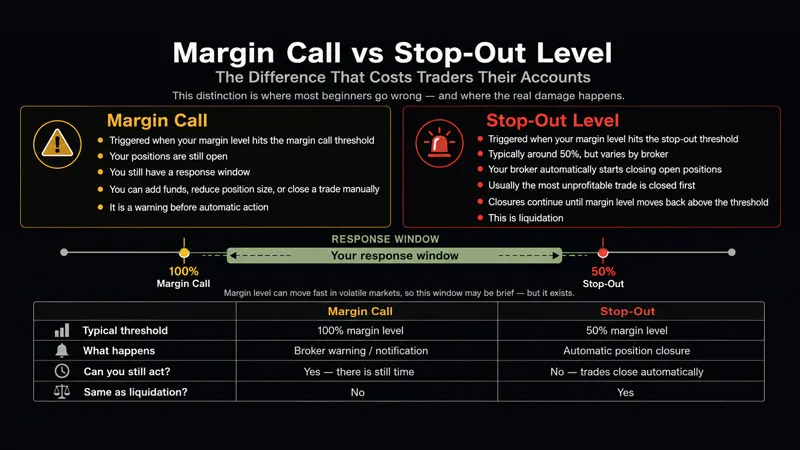
One important caveat: brokers don’t all use the same thresholds. Some set the margin call at 80%, others at 120%. Some stop out at 20%, others at 50%. Before you open a live account, look up the exact margin call and stop-out levels your broker uses. It matters more than most traders realise.
How Margin Level Is Calculated in Forex
The formula is simple, and knowing it turns “margin level” from a confusing platform number into something you can track and manage in real time.
Margin Level (%) = (Equity ÷ Used Margin) × 100
Both numbers are visible on your trading platform at any time. Equity updates in real time as your open trades fluctuate. Used margin is the sum of the margin requirements for all your open positions.
Let’s run through it with a real example. Meet Jamie — a beginner trader with a $2,000 account, using 50:1 leverage on EUR/USD.
Jamie opens one standard lot on EUR/USD. At 50:1 leverage, the margin requirement for one standard lot is $2,000 — the entire account balance. The trade starts moving against Jamie. After 80 pips of adverse movement, and at roughly $10 per pip per standard lot, Jamie has an unrealised loss of $800.
Equity is now: $2,000 − $800 = $1,200
Margin level: ($1,200 ÷ $2,000) × 100 = 60%
Jamie is already below the margin call threshold of 100% — which means a margin call was already triggered somewhere around 40 pips into this move. And at 60%, Jamie is just 10 margin-level percentage points from the stop-out at 50%. That’s roughly another 20 pips.
Now run the same scenario with a smaller position. Jamie opens 0.5 lots instead — requiring only $1,000 in used margin. The same 80-pip adverse move produces a $400 loss.
Equity: $2,000 − $400 = $1,600
Margin level: ($1,600 ÷ $1,000) × 100 = 160%
Still above the margin call level. Same account, same market move, same direction. The only difference was position size. This is why position sizing is a more important skill than entry timing — a well-timed entry on an oversized position will still get you margin called.
What Happens Step by Step During a Margin Call in Forex
When traders describe getting a margin call, they often describe it as something that happened to them suddenly. In reality, it’s a sequence — and there are intervention points along the way.
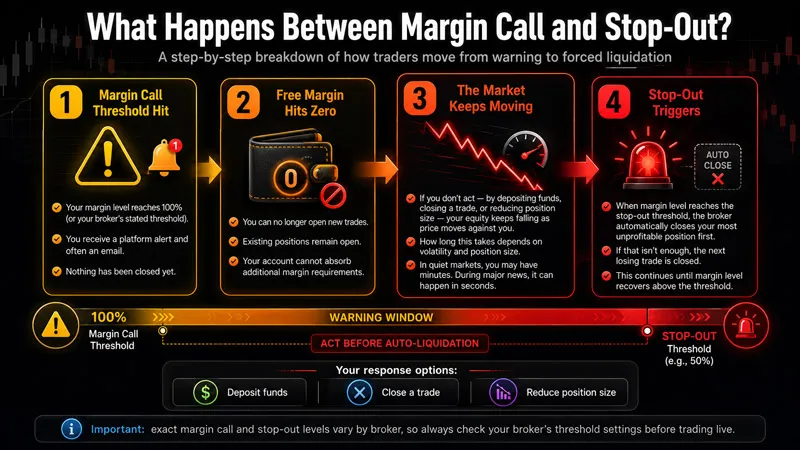
- Your equity falls to the margin call threshold. The broker detects that your margin level has hit 100% (or their stated threshold). You receive a notification — usually a platform alert and often an email. Nothing has closed yet.
- Free margin hits zero. You can no longer open any new trades. Your existing positions remain open, but the account can’t absorb any additional margin requirements.
- The market keeps moving. If you don’t act — by depositing funds, closing a trade, or reducing position size — your equity continues to fall with every pip the market moves against you.
- Margin level drops toward the stop-out. The time this takes depends entirely on how fast the market is moving and how large your positions are. In a ranging market, you might have minutes. During a major news event, it can happen in seconds.
- The stop-out triggers. When your margin level hits the stop-out threshold, the broker’s system automatically closes your most unprofitable open position. If that single closure doesn’t bring the margin level back above the threshold, the next most unprofitable trade closes. This continues until the margin level recovers.
There’s an important consequence here that traders often don’t anticipate: the stop-out doesn’t just close one trade and wait for your approval. It closes however many trades it needs to. If you had five open positions all moving in the wrong direction, all five could be closed before you can react.
By the time the stop-out fires, the margin call has already come and gone. The call was the warning. The stop-out is what happens when the warning is ignored.
Why Most Traders Get Margin Called — and What to Fix
Three causes account for almost every margin call. They rarely appear alone — they compound each other.
Over-leveraging positions. High leverage compresses the distance between your entry price and the margin call threshold. A 50:1 leveraged trade on a standard lot requires only a small adverse move before your margin level starts falling fast. Most beginners don’t connect the leverage ratio to the actual size of their margin buffer until they’re already staring at a notification. The fix is treating leverage as a ceiling, not a target. Just because your broker allows 100:1 doesn’t mean you should use it.
Trading without a stop-loss. A stop-loss closes your trade at a pre-defined loss before it can drain enough equity to threaten your margin level thresholds. Without one, a single bad trade can wipe out all free margin and push you straight into margin call territory. The fix is simple in theory and difficult in practice: set your stop-loss before you enter the trade, not after you’re already in it.

Overexposure across multiple positions. Every open trade adds to your used margin. Four open trades means four times the combined margin requirement. If those trades are on correlated pairs — EUR/USD, GBP/USD, AUD/USD — and a major dollar move hits, all four positions bleed equity simultaneously. The combined hit can breach the margin call level in minutes. The fix is tracking total used margin and total exposure, not just the risk on each individual trade.
This is exactly why prop trading firms enforce hard drawdown limits and position exposure rules. The structure isn’t arbitrary — it’s a coded version of the risk discipline most retail traders never consistently apply on their own. PropLynq, for example, places a hard ceiling on how much equity a trader can lose before the account is stopped. In practice, this forces conservative position sizing — the exact behaviour that prevents a margin call from ever forming. The firm doesn’t rely on traders to manage this themselves; the rules make undisciplined risk taking structurally impossible. Retail traders operating without these guardrails have to build the same discipline themselves. Most learn to respect it only after their first margin call.
How to Keep Your Margin Level Safe
The goal isn’t to handle a margin call competently. It’s to never develop the conditions for one in the first place.
- Keep your margin level above 200% at all times. This gives you a buffer two to four times the required margin. Most experienced traders won’t enter a new position if doing so would push their margin level below 200%. It isn’t a hard rule — it’s a working discipline.
- Size positions based on equity, not broker allowances. The broker’s maximum allowed position is not a recommendation. A common rule among funded traders: risk no more than 1–2% of total account equity on any single trade. At that level, a losing streak of 10 consecutive trades still leaves you with 80%+ of your account intact.
- Set your stop-loss before entering. Define your maximum loss on the trade before you’re in it. This is the single most effective mechanism for preventing a trade from draining equity far enough to threaten your margin thresholds.
- Avoid stacking correlated pairs. Being long EUR/USD and long GBP/USD at the same time is not diversification — it’s doubling your directional exposure to the US dollar. A single macro move wipes both positions at once. Check pair correlations before opening multiple trades in the same session.
- Monitor free margin during open trades. Your account balance doesn’t reflect your actual exposure. Free margin does. Check it regularly while trades are open, especially heading into news events where volatility can be extreme and spreads can widen.
Apply these habits consistently and your margin level stays well above the call threshold. A 30-pip adverse move becomes an uncomfortable unrealised loss — not a financial emergency.
If you’re working toward trading with institutional capital and want to get a funded account, understanding margin mechanics isn’t advanced knowledge — it’s the foundation every funded trader needs before they touch a live account.
Margin Call in Forex — The Short Version
A margin call is a warning, not a closure. It fires when your equity falls to your used margin — typically when your margin level hits 100%. The stop-out is what closes your trades — typically at 50%. The gap between them is your window to act. The formula is (Equity ÷ Used Margin) × 100, and you can check it on your platform at any time.
Traders who understand this don’t just survive margin calls — they build position sizes and risk habits that keep them from ever getting close to one.
If you want to trade inside a structure that enforces these habits from day one, explore prop firm programs built around disciplined risk management.
Miles Rowan Keene
As Senior Market Strategist at PropLynq, I write about market structure, trading psychology, and risk-first execution. My focus is on turning complex market behavior into clear, actionable lessons for both developing and experienced traders. I specialize in educational content covering funded account rules, drawdown management, trade planning, and strategy refinement, with the goal of helping traders build consistency through discipline, preparation, and a deeper understanding of how professional trading environments operate.
Weekly Trading Insights
Market analysis and trading tips delivered every Monday. No spam, unsubscribe anytime.
Comments
All comments are reviewed before publication · Text only · No links
No comments yet — be the first.