How to Pass a Prop Firm Challenge: Strategies for Success

The allure of managing institutional capital is stronger than ever in 2026. However, the statistics remain sobering: nearly 90% of traders fail their first evaluation. Why? Because they treat the challenge like a casino and the prop firm like a house they need to beat. But how to pass a prop firm challenge in 2026?
To pass a prop firm challenge, you must undergo a psychological shift. You are no longer trading for “pips” or “quick profits”; you are auditioning for a role as an Asset Manager. Proprietary firms aren’t looking for lucky gamblers—they are looking for disciplined risk managers who can protect their capital.
In this guide, we break down the practical, mathematical, and psychological frameworks behind how to pass a prop firm challenge and finally secure your funded account.
Phase 0: Choosing the Right Battlefield to Learn How to Pass a Prop Firm Challenge
Before placing your first trade, you must understand that not all challenges are created equal. Your strategy must align with the firm’s infrastructure if you want to understand how to pass a prop firm challenge and get a funded trading account.
- Understand the “Math of the Ask”: Is the profit target 10% with a 5% maximum drawdown? This requires a 2:1 success ratio just to stay afloat. Analyze these metrics before committing.
- Drawdown Types: Does the firm use a Balance-Based or Equity-Based (Trailing) drawdown? At PropLynq, we emphasize transparency in these rules, as “trailing” drawdowns can often catch beginners off guard during open-trade fluctuations.
- Execution Environment: Ensure the firm provides the spreads and slippage conditions that suit your style, whether you are a scalper or a swing trader.
Action Step: Visit our Challenge Page to compare different evaluation models and see how to pass a prop firm challenge with rules that match your current risk tolerance.
The “Golden Rules” of Risk Architecture for How to Pass a Prop Firm Challenge
If there is a “secret sauce” to passing, it isn’t a secret indicator; it is Risk Architecture, which sits at the core of how to pass a prop firm challenge. Most beginners fail because they over-leverage to hit profit targets quickly.
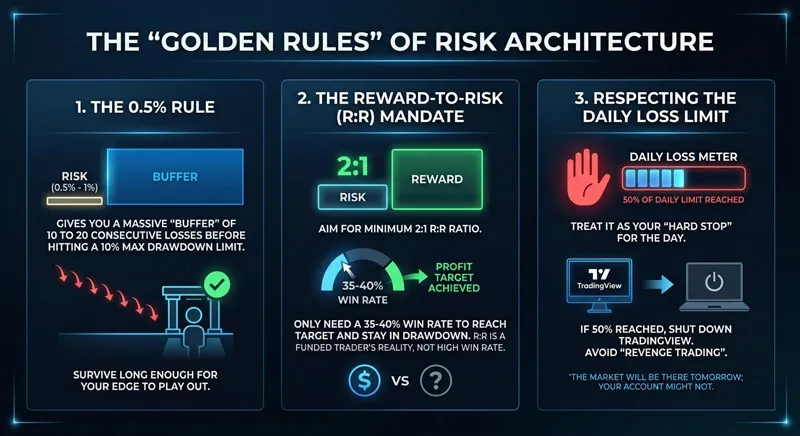
1. The 0.5% Rule
In a professional evaluation, your goal is to survive long enough for your edge to play out, because that is how to pass a prop firm challenge over time. By risking only 0.5% to 1% per trade, you give yourself a massive “buffer” of 10 to 20 consecutive losses before hitting a typical 10% maximum drawdown limit.
2. The Reward-to-Risk (R:R) Mandate
To pass efficiently, aim for a minimum 2:1 R:R ratio. Why? Because at a 2:1 ratio, you only need a 35-40% win rate to reach your profit target while staying well within drawdown limits. High win rates are a vanity metric; high R:R ratios are a funded trader’s reality.
3. Respecting the Daily Loss Limit
Treat the Daily Loss Limit as your “hard stop” for the day. If you reach 50% of your daily limit, the professional move is to shut down the Tradingview. The market will be there tomorrow; your account might not be if you engage in “revenge trading.”
Navigating Technical Hurdles in 2026: How to Pass a Prop Firm Challenge
Modern prop firms have evolved. To stay competitive, you must master the technical nuances that automated risk systems look for, because they directly affect how to pass a prop firm challenge.
- The Consistency Rule: Many firms now implement consistency algorithms to ensure your success isn’t the result of a single “lucky” gamble during a news event. Distribute your profit targets across multiple trades and days.
- EOD vs. Intraday Monitoring: Understanding when your drawdown is calculated—at the end of the day (EOD) or in real-time (Intraday)—changes how you manage overnight positions.
Practical Trading Strategies That Show How to Pass a Prop Firm Challenge
Passing a challenge requires more than a “strategy”—it requires an operational system. Here are three high-probability frameworks tailored for prop firm environments:
Strategy 1: The “Slow-In, Slow-Out” Approach
One of the biggest mistakes beginners make is trying to pass the challenge in 48 hours. Modern firms, like PropLynq, have removed time limits because consistency is central to how to pass a prop firm challenge naturally.
- The Logic: Divide your profit target (e.g., 10%) into four “milestones” of 2.5% each.
- The Execution: Once you hit a 2.5% milestone, reduce your risk by half. This protects your gains and ensures you don’t slide back into a massive drawdown after a winning streak.
Strategy 2: The News Event Shield
In 2026, high-impact news (CPI, NFP, Interest Rate decisions) creates “slippage” that can violate your maximum drawdown in milliseconds.
- The Rule: Unless you are a dedicated news trader with a proven edge, the most “practical” strategy is to be flat (all trades closed) 5 minutes before and after major red-folder events.
- The Benefit: This preserves your “mental capital.” You avoid the emotional rollercoaster of unpredictable volatility.
Strategy 3: Scaling into Profit (Not Drawdown)
Professional traders never “average down” on a losing position during an evaluation.
- The Tactic: If a trade is moving in your favor and has reached a 1:1 R:R, move your Stop Loss to Break-Even. Only then, consider adding a small second position. This allows you to catch “runners” that can hit your profit target in a single move without risking your initial capital.
The Psychological Pivot Behind How to Pass a Prop Firm Challenge
If Phase 1 is about proving you can make a profit, Phase 2 (the Verification stage) is about proving you can keep it. Many beginners pass Phase 1 through a bit of luck and then “blow” Phase 2 because of the “I’ve already made it” fallacy, which is why mindset is inseparable from how to pass a prop firm challenge.
1. The “Demo” vs. “Real” Mindset
Even though you are trading on a demo environment during the challenge, you must treat every dollar as if it were coming out of your personal bank account.
- The Fix: Physicalize your risk. If you are risking $500 on a trade, ask yourself: “Would I be comfortable losing this in cash right now?” If the answer is no, your position size is too high for your psychological threshold.
2. Managing the “Drawdown Anxiety”
The closer you get to the maximum drawdown limit, the more “frozen” your decision-making becomes.
- The Framework: If you hit 50% of your allowed maximum drawdown (e.g., you are down 5% on a 10% limit), stop trading for 24 hours. Analyze your journals. Are you losing because of the market, or because you are chasing the “breakeven” point?
From Successful Candidate to Funded Partner: How to Pass a Prop Firm Challenge After Verification
Passing the challenge is just the beginning. The transition from “Candidate” to “Funded Trader” requires a final shift in strategy.
The Payout Preparation
Once you pass, your focus shifts from “Growth” to “Preservation.”
- First Payout Goal: Your primary objective for your first month of being funded should be to secure any payout, no matter how small.
- The Psychological Win: Getting that first transfer to your bank account changes your DNA as a trader. It proves the system works.
Pro Tip: Familiarize yourself with our Payouts Page to understand the withdrawal schedules and how to optimize your profit-split transitions.
Conclusion: Consistency is the Only Shortcut
There is no “holy grail” indicator that will pass a prop firm challenge for you. The “practical strategy” for success is a boring one: unshakeable risk management and the patience to let your edge play out.
Proprietary trading is a marathon, not a sprint. By respecting the drawdown, mastering your psychology, and treating the firm’s capital with professional respect, you place yourself in the top 10% of traders globally.
Ready to take the first step toward professional funding?
- Explore our how it works steps to find your fit.
- Join our community of disciplined traders on the PropLynq Homepage.
The Mathematics of the Challenge: A Deep-Dive into How to Pass a Prop Firm Challenge
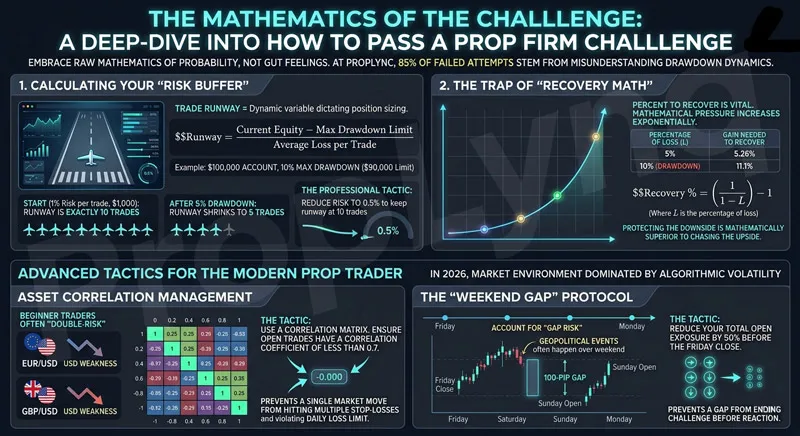
To pass an institutional-grade evaluation, you must move beyond “gut feelings” and embrace the raw mathematics of probability. At PropLynq, we analyze thousands of failed attempts, and 85% of them stem from a misunderstanding of Drawdown Dynamics.
1. Calculating Your “Risk Buffer”
Your “Risk Buffer” is the distance between your current equity and the maximum drawdown limit. It is not a static number; it is a dynamic variable that dictates your position sizing.
The formula for your remaining “Trade Runway” is:
$$Runway = \frac{Current\,Equity – Max\,Drawdown\,Limit}{Average\,Loss\,per\,Trade}$$
If you have a $\$100,000$ account with a $10\%$ max drawdown $(\$90,000$ limit$)$ and you risk $1\%$ per trade $(\$1,000)$, your runway is exactly $10$ trades. However, if you hit a $5\%$ drawdown, your runway shrinks to $5$ trades. At this point, a professional trader must reduce risk to $0.5\%$ to keep the runway at $10$ trades.
2. The Trap of “Recovery Math”
Understanding the Percent to Recover is vital. If you lose $5\%$ of your account, you need a $5.26\%$ gain to break even. But if you hit a $10\%$ drawdown, you need an $11.1\%$ gain to recover.
The mathematical pressure increases exponentially:
$$Recovery \% = \left( \frac{1}{1 – L} \right) – 1$$
(Where $L$ is the percentage of loss)
This is why “Protecting the Downside” is mathematically superior to “Chasing the Upside” during an evaluation.
Advanced Tactics for the Modern Prop Trader
In 2026, the market environment is dominated by algorithmic volatility. To navigate this, consider these institutional-grade tactics:
Asset Correlation Management
Beginner traders often “double-risk” without realizing it. If you are long on EUR/USD and GBP/USD simultaneously, you aren’t diversified; you are simply doubled-up on “USD Weakness.”
- The Tactic: Use a correlation matrix. Ensure your open trades have a correlation coefficient of less than 7. This prevents a single market move from hitting multiple stop-losses and violating your Daily Loss Limit.
The “Weekend Gap” Protocol
If your challenge allows weekend holding, you must account for “Gap Risk.”
- The Tactic: Reduce your total open exposure by 50% before the Friday close. Significant geopolitical events often happen over the weekend, and a 100-pip gap against your position on Sunday market-open can end a challenge before you can even react.
Frequently Asked Questions About How to Pass a Prop Firm Challenge
Can I use Expert Advisors (EAs) or Algos?
Yes, but with a caveat. Most professional firms, including PropLynq, require that the EA is not based on “toxic” strategies like Martingale or High-Frequency Trading (HFT) “arbitrage.” Your EA should demonstrate a clear, logic-based edge that respects drawdown limits.
What is the “Consistency Rule” and how do I pass it?
The Consistency Rule prevents traders from passing by “gambling” on a single lucky trade. Typically, no single trading day should account for more than 30-40% of your total profit target. To pass, you must demonstrate a repeatable process over several trading sessions.
Is News Trading allowed?
While many firms allow trading during news, the slippage during high-impact events can be lethal. We recommend beginners stay “flat” during NFP and CPI releases to avoid technical violations caused by spread widening.
The Ultimate “Pre-Challenge” Checklist for How to Pass a Prop Firm Challenge
Before you click “Buy Challenge,” ensure you can check every box on this list:
- [ ] Defined Edge: I have backtested my strategy over at least 100 trades.
- [ ] The Math: I know exactly what $0.5\%$ risk looks like in lots for my chosen pairs.
- [ ] Environment: I have a stable internet connection and a distraction-free trading desk.
- [ ] Mental State: I am not trading with “scared money” or under financial pressure to pay bills.
- [ ] Platform Mastery: I know how to set “Break-Even” stops and partial TPs on the MT5/cTrader platform.
Final Thoughts on How to Pass a Prop Firm Challenge
Passing a prop firm challenge is the ultimate validation of a trader’s skill. It is the bridge between being a retail hobbyist and a professional capital manager. By focusing on Risk Architecture, respecting the Mathematics of Drawdown, and maintaining Psychological Discipline, you aren’t just passing a test—you are building a career.
The capital is waiting. The question is: Do you have the discipline to manage it?
Ready to Begin? Explore our institutional-grade challenges on the PropLynq Homepage or join our Community Discord to learn from funded traders who have already mastered the process.
Stop failing your evaluations. Master how to pass a prop firm challenge using 5 proven, practical strategies. From risk management to consistency rules, get the blueprint used by the top 10% of funded traders in 2026.
Miles Rowan Keene
As Senior Market Strategist at PropLynq, I write about market structure, trading psychology, and risk-first execution. My focus is on turning complex market behavior into clear, actionable lessons for both developing and experienced traders. I specialize in educational content covering funded account rules, drawdown management, trade planning, and strategy refinement, with the goal of helping traders build consistency through discipline, preparation, and a deeper understanding of how professional trading environments operate.
Weekly Trading Insights
Market analysis and trading tips delivered every Monday. No spam, unsubscribe anytime.


Comments
No comments yet — be the first.