How to Trade Forex News: A Practical Guide to News Trading in Forex
Forex news can move a chart faster than any clean technical setup. A pair that was respecting structure five minutes ago can break through support, reverse through resistance, widen its spread, and trigger stops before a trader has time to think. That is why news trading in forex should never mean “guess the headline and click buy or sell.” It needs a process.
The goal is not to predict every data release perfectly. The goal is to know which events matter, how price usually behaves around them, when execution risk is too high, and how much account risk you are willing to expose. For a funded trader, that last point matters even more because drawdown rules can be breached by floating losses, not just closed trades.
This guide from PropLynq explains how to trade forex news with a practical framework: what to watch, when to avoid trading, how to build a plan before the release, and how to protect yourself from the two risks that usually hurt news traders most — slippage and emotional over-sizing.
What News Trading in Forex Actually Means
News trading in forex is the practice of planning trades around scheduled economic events, central-bank decisions, inflation reports, employment data, geopolitical shocks, or other information that can change expectations for a currency. The important word is “planning.” A trader who reacts blindly to a candle is not trading news; they are trading adrenaline.
The forex market moves on expectations. If traders expect the Federal Reserve to keep rates high, the dollar may strengthen before the meeting even happens. If inflation data comes in far below expectations, the move may be sharp because the market has to reprice that assumption quickly. Sometimes the number is “good” but the currency falls because traders were positioned for an even stronger result. That is why the headline alone is not enough.
A useful news trader looks at three layers when he is trading in the best prop firm. First, what is the market expecting? Second, how large is the surprise compared with that expectation? Third, does price confirm the idea after spreads and volatility settle? News trading in forex becomes more controlled when you treat the release as a volatility event rather than a magic signal.
News trading in forex also has two different styles. Some traders position before the release because they have a directional thesis. Others wait until after the release and trade the reaction once the first violent movement has passed. The second approach is usually cleaner for beginners because it reduces the need to predict the number in advance.
The Short Answer: How to Trade Forex News Without Gambling
The safest way to approach news trading in forex is to prepare before the event, avoid the first chaotic seconds if you do not have a tested execution model, and only trade when the setup still makes sense after spread, stop distance, and account risk are included.
A simple news trading in forex process looks like this:
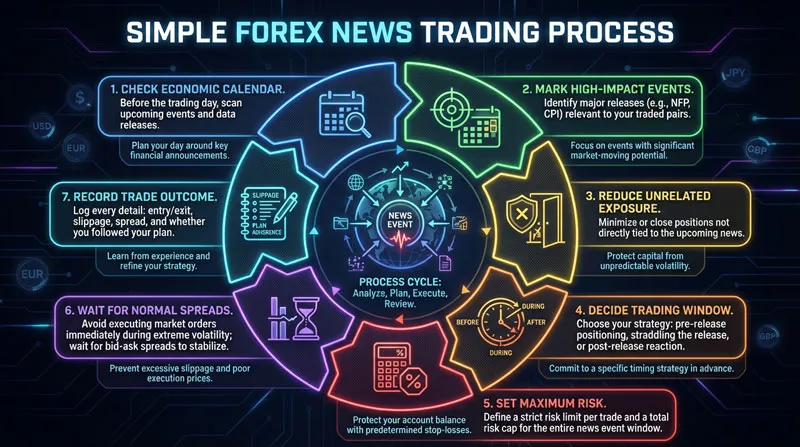
- Check the economic calendar before the trading day starts.
- Mark high-impact events for the currencies you trade.
- Reduce or close unrelated exposure before the release if the event can affect your pair.
- Decide in advance whether you will trade before, during, or after the release.
- Set a maximum risk per trade and a maximum risk for the whole news window.
- Wait for spreads to normalize before using market execution.
- Record the trade outcome, including slippage, spread, and whether you followed the plan.
The best news traders are not the ones who catch every spike. They are the ones who know when not to trade. If the stop must be placed too wide, the spread is abnormal, or the pair is whipping both directions without structure, passing on the setup is a valid decision.
The Forex News Events That Usually Matter Most
In news trading in forex, not every calendar item deserves your attention. Some releases barely move the market. Others can change the entire session. The events below tend to matter because they affect interest-rate expectations, growth expectations, inflation pressure, or risk sentiment.
| News event | Why it matters | Pairs often affected | Main trading risk |
|---|---|---|---|
| Central-bank rate decisions | They can change interest-rate expectations and forward guidance. | Pairs involving that currency, especially USD, EUR, GBP, JPY, CAD, AUD, NZD, and CHF pairs | Fast repricing, wide spreads, and reversals during the press conference |
| Inflation data such as CPI or PCE | Inflation affects the market’s view of future rate cuts or hikes. | Major pairs and crosses tied to the reporting country | Large first move followed by a second move if details contradict the headline |
| Employment data such as NFP | Jobs data can shift growth and rate expectations at the same time. | USD pairs, gold, indices, and risk-sensitive currencies | Whipsaws caused by mixed unemployment, wage, and payroll figures |
| GDP and retail sales | They show growth momentum and consumer demand. | Currency of the reporting economy and its major crosses | Delayed reaction if the market focuses on revisions or subcomponents |
| Geopolitical or unscheduled news | Unexpected events can create risk-off movement across markets. | Safe-haven currencies, commodity currencies, gold, oil-sensitive pairs | Gaps, poor liquidity, and no time to prepare |
For traders still choosing which markets to focus on, major pairs usually offer better liquidity and tighter spreads than many exotic pairs. PropLynq’s guide to major forex currency pairs is a useful companion because news trading in forex is much harder when the pair already has unstable spread behavior before the event.
Three Ways to Trade Forex News
There is no single correct method for news trading in forex. What matters is whether the method fits your skill, execution speed, risk limits, and broker conditions. Most traders fall into one of three approaches.
1. Pre-news positioning
In news trading in forex, pre-news positioning means entering before the release because your analysis suggests the market is mispriced. For example, you might believe the market is underestimating inflation risk and expect the currency to strengthen if the report confirms your view.
This approach can produce a good entry if the thesis is right, but it carries the highest surprise risk. A slightly different number, a revised previous figure, or a conflicting subcomponent can invalidate the idea instantly. It is not enough to be “mostly right” if the spread widens and the stop is too close.
2. Breakout trading during the release
Breakout traders try to capture momentum as price breaks a level after the news hits. This can be done with market orders or pending stop orders. The attraction is obvious: when news creates real repricing, price can travel quickly.
The risk is equally obvious. During the most volatile seconds, a buy stop or sell stop can be filled at a worse price than expected. If you use pending orders around news, review the logic in PropLynq’s guide to pending orders in forex and remember that the order type does not protect you from poor execution.
3. Post-news continuation or reversal
In news trading in forex, post-news trading waits for the initial spike to finish. The trader then looks for continuation after a clean break, or a reversal if the first move was overextended and rejected. This is often the most practical method for developing traders because it lets them see the market’s reaction before risking capital.
The downside is that the “best” price may be gone. That is acceptable. In news trading in forex, a slightly later entry with clearer structure can be better than an early entry inside a spread explosion. A missed trade is cheaper than a badly executed trade.
A Step-by-Step Process for News Trading in Forex
A repeatable process for news trading in forex reduces the chance that a news event turns into a random bet. Use the steps below as a practical operating checklist.
- Start with the calendar. Before the session begins, identify high-impact events for the currencies you trade. Do not wait until a candle explodes to discover that CPI was scheduled.
- Define the affected pairs. If U.S. data is coming, USD pairs, gold, and risk assets may react. If the Bank of England is speaking, GBP pairs deserve attention. Avoid carrying correlated positions that all depend on the same news outcome.
- Mark the technical levels before the release. Identify the nearest range high, range low, liquidity sweep area, support, resistance, and invalidation point. Do this before emotions rise.
- Choose your trading mode. Decide whether you are avoiding the event, trading after the release, or using a specific tested news setup. Do not switch modes mid-spike because price looks exciting.
- Set the risk cap. Define the maximum amount you can lose if the news trade fails. For funded traders, this should consider both daily loss and total drawdown, not only personal comfort.
- Check spread and slippage conditions. If spread is too wide, either reduce size, widen the plan properly, or do not trade. PropLynq’s guide to slippage in forex explains why fast markets can fill orders away from the expected price.
- Wait for confirmation. Confirmation might be a candle close, a retest, a lower-timeframe structure shift, or a failed breakout. The rule depends on your system, but it must be defined before entry.
- Log the execution. Record the planned entry, actual fill, spread, stop distance, result, and whether the trade followed your rule. Without that data, you cannot tell if your news trading in forex has an edge or just occasional lucky wins.
Scenario Example: Trading NFP Without Chasing the First Candle
Imagine EUR/USD is ranging before U.S. Non-Farm Payrolls. The range high is 1.0860, the range low is 1.0805, and price is sitting near the middle. You have no position before the release because the stop distance is unclear and the number could move the pair in either direction.
The data comes out stronger than expected. EUR/USD drops hard, breaks the range low, and trades into 1.0785 within seconds. A reactive trader sells immediately because the candle is large. A prepared trader waits. The spread is still wider than normal, the first candle has already traveled far, and the stop would need to sit above the broken range to make technical sense.
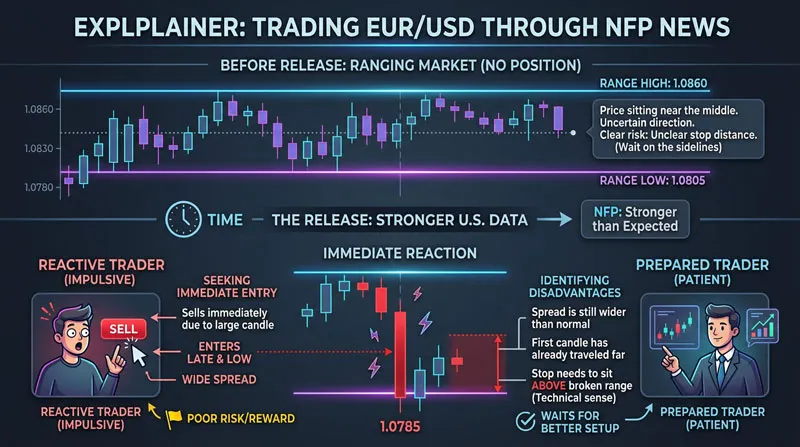
Five minutes later, price retests the old range low near 1.0805 and fails to reclaim it. Spread has narrowed. The trader now has a clearer plan: sell the failed retest, place the stop above the retest high, and target the next support zone. This trade may still lose, but it is no longer just a reaction to the headline. It has structure, invalidation, and measurable risk.
The lesson is simple: in news trading in forex, the first move is not always the best trade. Sometimes the higher-quality opportunity appears after the market reveals whether the breakout is accepted or rejected.
Risk Controls Funded Traders Need During News
In news trading in forex, volatility is not automatically bad. Uncontrolled exposure to news volatility is the problem. Funded traders should be especially careful because a trade can breach rules through open equity movement before it ever closes.
PropLynq’s evaluation rules explain that daily drawdown is measured from equity at the start of the trading day and that floating and realized P&L count toward drawdown checks. That matters during news because a temporary spike against your position can still damage the account even if price later returns.
Use these controls before trading a high-impact release:
- Reduce risk per trade. A normal 1% risk may be too large if the spread and slippage environment is abnormal.
- Avoid stacking correlated trades. Buying GBP/USD and selling USD/CAD before the same U.S. release may create one large dollar bet, not two independent trades.
- Respect the stop location. Do not tighten the stop randomly just to make the lot size bigger. If the technical stop is too wide, the trade may not fit.
- Set a daily news limit. Decide how many attempts you are allowed during the event. Two failed attempts may be enough.
- Check account rules before the trade. If your account is already close to a daily loss limit, the correct news trade may be no trade.
Traders comparing account structures can review current PropLynq trading accounts to understand how different targets, drawdown limits, leverage, and permissions shape the risk box around a strategy.
Common Mistakes in News Trading in Forex
The mistakes below are common in news trading in forex because news creates urgency. A trader feels that if they do not act now, the opportunity will disappear. That feeling is exactly what makes the event dangerous.
- Trading the headline without the expectation. A strong number can still disappoint if the market expected something stronger.
- Ignoring revisions and subcomponents. Employment, inflation, and growth reports often contain details that change the first interpretation.
- Using the same position size as a quiet session. Volatility changes the real risk of the trade, even if the lot size looks familiar.
- Entering while spreads are distorted. A setup that looks profitable on the chart can become poor once execution cost is included.
- Moving the stop after slippage. Widening the stop emotionally turns a planned loss into an uncontrolled loss.
- Revenge trading the second spike. After one loss, traders often try to “make it back” while volatility is still unstable.
- Forgetting the account context. A trade that is acceptable on a personal account may be too aggressive inside a funded challenge with defined drawdown limits.
The cleanest fix is to write a news playbook. It should state which events you trade, which pairs you trade, how long you wait after the release, what spread is acceptable, how you size positions, and when you stop for the day.
When You Should Not Trade the News
The professional skill in news trading in forex is not only knowing how to enter. It is knowing when the conditions are too poor to justify the trade. Use this checklist before any high-impact event.
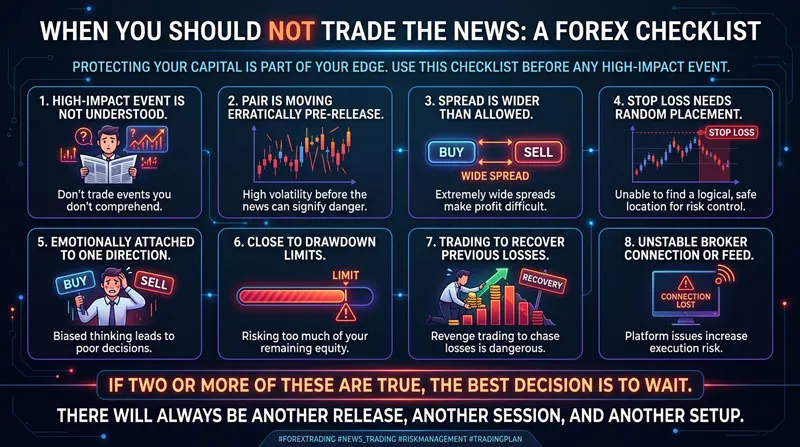
- The calendar event is high impact, but you do not understand why it matters.
- The pair is already moving erratically before the release.
- The spread is wider than your plan allows.
- Your stop loss would need to be placed at a random level.
- You are already emotionally attached to one direction.
- You are close to your daily or total drawdown limit.
- You need this one trade to recover previous losses.
- Your broker connection, platform, or data feed is unstable.
If two or more of these are true, waiting is usually the better decision. There will always be another release, another session, and another setup. Protecting your account is part of the edge.
How PropLynq Handles News Trading
For news trading in forex, PropLynq’s published rules state that news trading is allowed on Stellar 2-Step accounts and that traders can open and close trades before, during, and after high-impact events such as FOMC, NFP, and CPI. The rules also warn that spreads can widen significantly during news and that slippage is a normal part of news trading.
That distinction matters. Permission to trade news does not mean the market becomes safer. It means the trader is responsible for building a plan that fits the account rules. PropLynq also lists fair-play restrictions such as latency arbitrage, cross-firm hedging, account sharing, tick scalping, and strategies that depend on guaranteed fills during extreme volatility gaps.
The practical takeaway is that news trading in forex can fit a PropLynq-style funded environment only when the strategy is rule-aware. The trade should make sense after you account for drawdown, spread, slippage, position size, and the possibility of a fast reversal.
Final Thoughts on News Trading in Forex
News can create some of the cleanest movement of the week, but it can also expose every weak part of a trader’s process. If your plan depends on perfect fills, instant reaction time, oversized positions, or hope that the first candle keeps running, the risk is probably too high.
A better approach is to treat news trading in forex as a structured volatility strategy. Know the event, know the expectation, wait for the market to reveal its reaction, and only trade when the risk still fits your account. The goal is not to catch every news move. The goal is to survive the messy ones and participate only when the opportunity is clear enough to deserve risk.
Miles Rowan Keene
As Senior Market Strategist at PropLynq, I write about market structure, trading psychology, and risk-first execution. My focus is on turning complex market behavior into clear, actionable lessons for both developing and experienced traders. I specialize in educational content covering funded account rules, drawdown management, trade planning, and strategy refinement, with the goal of helping traders build consistency through discipline, preparation, and a deeper understanding of how professional trading environments operate.
Weekly Trading Insights
Market analysis and trading tips delivered every Monday. No spam, unsubscribe anytime.


Comments
No comments yet — be the first.