Top 7 Major Forex Currency Pairs to trade

The short answer is this: the top 7 major forex currency pairs are the U.S. dollar, euro, Japanese yen, British pound, Swiss franc, Canadian dollar, Australian dollar, and often the New Zealand dollar. The best one to trade is not “the strongest” currency. It is the pair whose volatility, session timing, spread behavior, and news flow fit the way you actually trade. For most beginners, that usually means starting with EUR/USD, then looking at USD/JPY only after they understand how each pair moves.
That distinction matters because traders often ask what are the major currency pairs in forex which one to trade as if there is one universal winner. There is not. One trader needs calm pricing and tight spreads. Another needs more movement during London or New York. Another only trades Asian hours and naturally finds more relevance in yen pairs. The right choice is about fit, not hype.
What are the 7 major forex currency pairs?
When traders talk about the forex majors, they usually mean the currencies that sit behind the most widely traded and most liquid pairs. In retail trading, that conversation almost always starts with USD, EUR, JPY, GBP, CHF, CAD, AUD, and NZD. The classic “major pairs” are then built around the U.S. dollar:
- EUR/USD
- USD/JPY
- GBP/USD
- USD/CHF
- USD/CAD
- AUD/USD
- NZD/USD
There is a useful nuance here. In retail education, the majors are still usually framed as those classic USD pairs. But global market data can shift the ranking of what is most actively traded at a given time. That is why it helps to separate the retail label “major pairs” from the institutional question “which pairs are currently seeing the most turnover?”
Major forex pairs traders usually start with
Not every major currency behaves the same way. Some pairs are smoother. Some are faster. Some react heavily to rate expectations and macro headlines. Some move best during very specific sessions. If you are trying to decide what are the major forex currency pairs, which one to trade, this is the part that matters most.
| Pair | What it is known for | Best fit tendency | Main caution |
|---|---|---|---|
| EUR/USD | Deep liquidity, tight spreads, broad analyst coverage | Beginners, structured intraday traders, macro traders | Can still whipsaw around major data |
| USD/JPY | Strong reaction to yields, BoJ policy, risk sentiment | Session-aware traders, news and momentum traders | Can move sharply on policy headlines |
| GBP/USD | Higher average movement than EUR/USD | Experienced day traders who can handle more volatility | More violent intraday swings and stop hunts |
| USD/CHF | Defensive-flow reputation, often tied to risk sentiment | Macro traders and correlation-aware traders | Can be less intuitive for beginners |
| USD/CAD | Sensitive to oil and North American data | Traders who follow commodities and U.S./Canada releases | Oil moves can change the rhythm quickly |
| AUD/USD | China-linked sentiment, commodity sensitivity, Asia-Pacific relevance | Swing traders and traders active in Asia/London overlap | Can be headline-sensitive around China risk |
| NZD/USD | Clean trending stretches at times, smaller global focus | Selective swing traders | Usually wider spreads and thinner liquidity than EUR/USD |
You are not choosing a flag. You are choosing market behavior. That is why a trader can understand the list of majors perfectly and still choose the wrong pair for their schedule or psychology.
Which Forex major currency pair is best to trade?
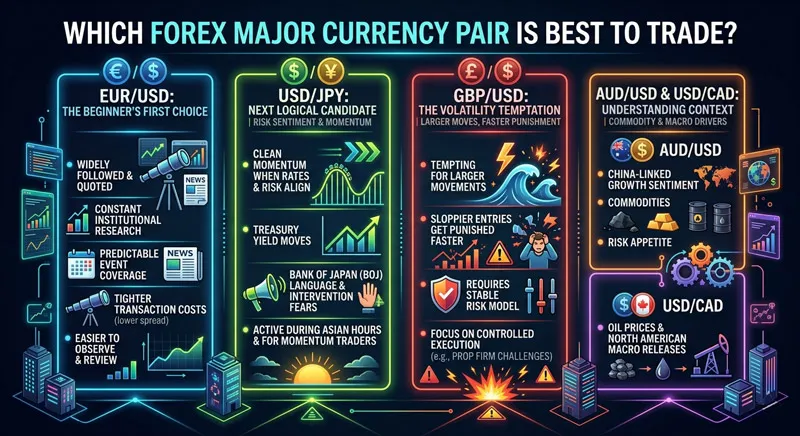
For most newer traders, EUR/USD is usually the best first choice. It is widely followed, heavily quoted, and easier to study because there is constant institutional research, predictable event coverage, and usually tighter transaction costs than more volatile alternatives. That does not mean EUR/USD is always easy. It means the market is easier to observe, compare, and review.
USD/JPY is often the next logical candidate. It can be very clean when rate expectations and risk sentiment line up, but it can also jump fast on Bank of Japan language, Treasury yield moves, or intervention fears. Traders who are active during Asian hours or who like momentum often keep it high on their list because the pair can show intention more clearly than slower markets.
GBP/USD is one of the major forex currency pairs that many beginners are tempted to trade too early. It offers bigger movement, and bigger movement looks attractive. But bigger movement also means sloppier entries get punished faster. If your risk model is not stable yet, learning how to pass a prop firm challenge with controlled execution usually matters more than chasing the fastest chart on your platform.
AUD/USD and USD/CAD can be excellent once you understand what drives them. AUD/USD often matters more when China-linked growth sentiment, commodities, and risk appetite are in focus. USD/CAD matters more when oil and North American macro releases are driving flows. Those pairs are not worse. They just reward traders who understand their context instead of trading them as generic alternatives to EUR/USD.
A practical answer by trader type
- Beginner: Start with EUR/USD.
- Momentum trader: Add USD/JPY once you can track rates and session timing.
- Higher-volatility intraday trader: Consider GBP/USD, but only with tighter discipline.
- Commodity-aware trader: Look at AUD/USD or USD/CAD.
- Asia-session trader: USD/JPY and AUD/USD usually deserve more attention than GBP/USD.
When each pair tends to make the most sense
One of the easiest ways to pick the wrong market is to ignore session fit. Traders often build a watchlist based on popularity, then wonder why the pair feels slow, messy, or too expensive when they open the chart. A better approach is to ask when the pair is naturally most active and whether that lines up with your own routine.
EUR/USD usually gets the most attention during London and the London–New York overlap. That is one reason it is such a common learning pair: the market is heavily watched, the flow is deep, and the structure is easier to review after the fact. Building a repeatable TradingView workflow helps here because session behavior becomes clearer when you review the same pair the same way each day. USD/JPY can stay relevant across more than one major session, but it becomes especially important when Japanese policy headlines, U.S. yields, or broad risk sentiment are in focus.
GBP/USD often rewards traders who are present for London trading and who can react to faster bursts of momentum. AUD/USD and NZD/USD can make more sense for traders who monitor Asia-Pacific hours or who build swing ideas around broader risk tone. USD/CAD becomes much more interesting when oil and North American releases are clearly shaping price.
That is why the best watchlist is usually smaller than traders think. You do not need all the major forex currency pairs on screen at once. You need the two or three pairs that match your session, your strategy, and your ability to prepare properly.
Scenario examples: the same trader can need different pairs
Imagine two traders asking the same question about what to trade. Trader A is available during London open, prefers cleaner structure, and is still learning how macro releases affect price. Trader B lives in a time zone where Asian market hours are easier to follow and prefers breakout-style movement.
Trader A probably gets more value from EUR/USD first. The pair gives enough movement to matter, but usually not so much noise that every mistake becomes chaos. It is easier to build a review process around it because news, analyst commentary, and technical reaction points are heavily covered.
Trader B may naturally connect better with USD/JPY or AUD/USD. That does not mean those pairs are objectively better. It means they align with the trader’s available hours and the type of flow they can realistically observe in real time.
Now imagine a third trader who already has solid execution but wants bigger intraday range. That person may do fine on GBP/USD. The same pair that hurts a beginner can work well for someone who already knows how to manage pace, size, and stop placement. The market did not change. The fit changed.
What people get wrong about major forex currency pairs
The biggest mistake is assuming that the “best” pair is the one that moves the most. More movement can help a good setup reach target faster, but it can also make weak entries, oversized positions, and emotional decisions much more expensive.
The second mistake is thinking the retail list of major forex currency pairs is the same as the list of pairs you personally should trade. Market popularity and personal fit are different questions. A pair can be globally important and still be a poor match for your schedule, your psychology, or your risk tolerance.
The third mistake is ignoring execution cost. In rule-based trading, a pair with lower friction is often more forgiving for repetition and review than a pair that looks exciting but quietly eats edge through spreads, slippage, and impulsive re-entry.
There is also a more current market nuance worth understanding. The retail label “majors” still points to the classic seven USD pairs, but global turnover data can tell a more dynamic story. That does not suddenly rewrite beginner pair selection. It simply reminds traders that category labels and real-world flow leadership are not always identical.
How to choose the right pair for your strategy
If you want a simple framework for what are the major forex currency pairs, which one to trade, use this checklist before you commit to a watchlist.
- Do I trade during the pair’s active session, or am I forcing trades when liquidity is thinner?
- Can I handle the pair’s normal intraday range without widening stops randomly?
- Do I understand the main drivers: rates, risk sentiment, commodities, central bank language, or regional data?
- Are the spreads and execution conditions suitable for my timeframe?
- Does this pair match my method, or am I choosing it because social media says it moves?
- Can I review this pair consistently enough to learn its rhythm?
If you answer “no” to most of those questions, the pair is probably wrong for you right now. That is not a permanent judgment. It is just a watchlist decision. Most traders improve faster by getting deeply familiar with one or two majors than by jumping between six pairs every week. That is also why your market choice should line up with your broader method, especially if you are comparing the best trading styles for prop challenges and trying to figure out which type of execution really suits you.
How this choice matters for funded traders and prop-style rules
Pair selection becomes even more important when you are trading inside evaluation rules or a funded-account model. A fast pair with wider intraday swings can feel exciting on a personal account, but the same behavior can be much harder to manage when daily loss and maximum drawdown rules are fixed. That is one reason traders comparing a funded trading account should not stop at headline account size.
It also helps to connect pair choice to account structure. Before committing, it makes sense to compare funded account models and see whether your preferred major forex currency pairs and holding style fit the drawdown rules, profit targets, and pace the account expects. If your style depends on faster movement, wider stops, or holding through normal noise, account structure matters just as much as pair choice.
A good rule for the first three months is simple: master one pair, understand a second, and ignore the rest unless your data proves they add value. Most watchlists are too wide long before the trader has earned that complexity. Repetition is usually a bigger edge than variety.
Final answer: which one of the major forex currency pairs to trade?
The major forex currency pairs are usually USD, EUR, JPY, GBP, CHF, CAD, AUD, and NZD, and the classic major pairs are the seven USD-based pairs built from them. If you want one practical answer on which to trade first, start with EUR/USD. Add USD/JPY next if you understand session timing and rate sensitivity. Move to GBP/USD only when your execution is already disciplined enough to handle faster swings.
Do not choose a major pair because it is famous. Choose it because its volatility, cost, news rhythm, and trading session match your method. That is the real answer most traders skip when they rush into the wrong market.
Miles Rowan Keene
As Senior Market Strategist at PropLynq, I write about market structure, trading psychology, and risk-first execution. My focus is on turning complex market behavior into clear, actionable lessons for both developing and experienced traders. I specialize in educational content covering funded account rules, drawdown management, trade planning, and strategy refinement, with the goal of helping traders build consistency through discipline, preparation, and a deeper understanding of how professional trading environments operate.
Weekly Trading Insights
Market analysis and trading tips delivered every Monday. No spam, unsubscribe anytime.


Comments
No comments yet — be the first.