What is Best Trading Styles for Prop Challenges in 2026

When beginners search for the Best Trading Styles for Prop, they usually compare the wrong things first. They ask which style is faster, which style can hit targets quicker, or which style looks more exciting on social media. But a prop challenge is not a normal trading environment. It is a rule-based test, and the Best Trading Styles for Prop are rarely the styles that look the most aggressive on paper. They are the styles that create the least friction with drawdown limits, minimum trading days, time pressure, and trader psychology.
For a beginner, that distinction matters more than most marketing pages admit. Scalping can look efficient because it offers more opportunities and faster feedback. Swing trading can look safer because it slows everything down and reduces decision frequency. But inside a challenge, neither survives just because of its label. The Best Trading Styles for Prop are the styles that match the trader’s routine, execution skill, and emotional control.
For most beginners, that answer usually points toward slower and cleaner decision-making before it points toward speed. Swing trading or lower-frequency execution is often easier to manage because it reduces the pace of decision-making and gives more room for planning. Scalping can work, but it usually rewards traders who already have a tested intraday process and the discipline to stay precise under pressure. So before choosing a style for prop trading, it is smarter to measure the friction it creates than to chase the version of the Best Trading Styles for Prop that looks most impressive online.
Best Trading Styles for Prop start with the wrong question
Most beginners start by asking which style is “best,” but that lens is too abstract for a challenge account. A strategy does not pass because it sounds smart. It passes because it can operate cleanly inside the rules. The Best Trading Styles for Prop are not automatically the ones with the highest theoretical upside. They are the ones that can survive the account structure the trader is actually buying.
Why the Best Trading Styles for Prop depend on compatibility
If a trader needs constant action, takes too many impulsive entries, or struggles to stop after a small losing streak, even a valid strategy can break down quickly under daily loss limits. On the other side, a trader may choose swing trading because it seems calmer, then discover that overnight exposure or slow progress toward the target creates a different kind of stress. In both cases, the problem is not the style itself. The problem is the mismatch between the style and the challenge environment.
That is why generic comparisons often leave readers unsatisfied. They tell you that scalping is fast and swing trading is slower, which is true but incomplete. What they usually fail to explain is how a style behaves once a prop firm adds guardrails. A challenge with a 5% daily loss limit, 10% max drawdown, minimum trading days, and unlimited time changes the decision completely. Suddenly, the Best Trading Styles for Prop are not the ones that feel exciting. They are the ones you can repeat without colliding with those limits.
Why the Best Trading Styles for Prop are really a friction decision
A better framing is this: a prop challenge is a pressure test for your decision process. It shows whether your style encourages rushed execution, emotional clustering of losses, or poor trade selection when the target feels far away. Once you view the problem that way, the search for the Best Trading Styles for Prop becomes more practical.
The first friction is rule friction. This is the pressure created when your natural way of trading runs into the account rules. If your style needs freedom to hold through news or over the weekend, restrictions in those areas matter immediately. If your style produces many small trades, daily drawdown limits matter more. If you are patient and selective, minimum trading days and unlimited-time structures may support you better than a model that pushes for speed.
The second friction is execution friction. Scalping places much more weight on timing, consistency, and cost sensitivity. Small mistakes matter more when the trade idea itself aims for smaller moves, which is why spread, slippage, and rushed entries become such a big part of the conversation. Swing trading reduces some of that pressure because decisions happen less often and setups usually have more room to develop. But lower frequency does not mean no execution burden. It means the burden shifts from fast reaction to better planning, sizing, and patience.
The third friction is psychological friction. Some traders cannot tolerate inactivity, so they force scalps just to feel involved and to pass a prop firm challenge as fast as they can. Others cannot tolerate open trades sitting overnight, so they sabotage swing positions early even when the plan is still valid. One trader breaks rules because speed amplifies emotion. Another breaks the plan because waiting feels unbearable. That is why the Best Trading Styles for Prop are rarely the styles that sound most impressive. They are the ones that keep rule friction low, execution demands manageable, and psychological pressure inside the trader’s actual tolerance.
Best Trading Styles for Prop fail differently in scalping and swing trading
The surface-level comparison between scalping and swing trading is easy. One is faster, one is slower. One demands more market time, one demands more patience. But the Best Trading Styles for Prop are easier to judge when you look at how each style usually fails inside a challenge, not just how each style looks in a textbook. Getting a funded trading account is more than that.
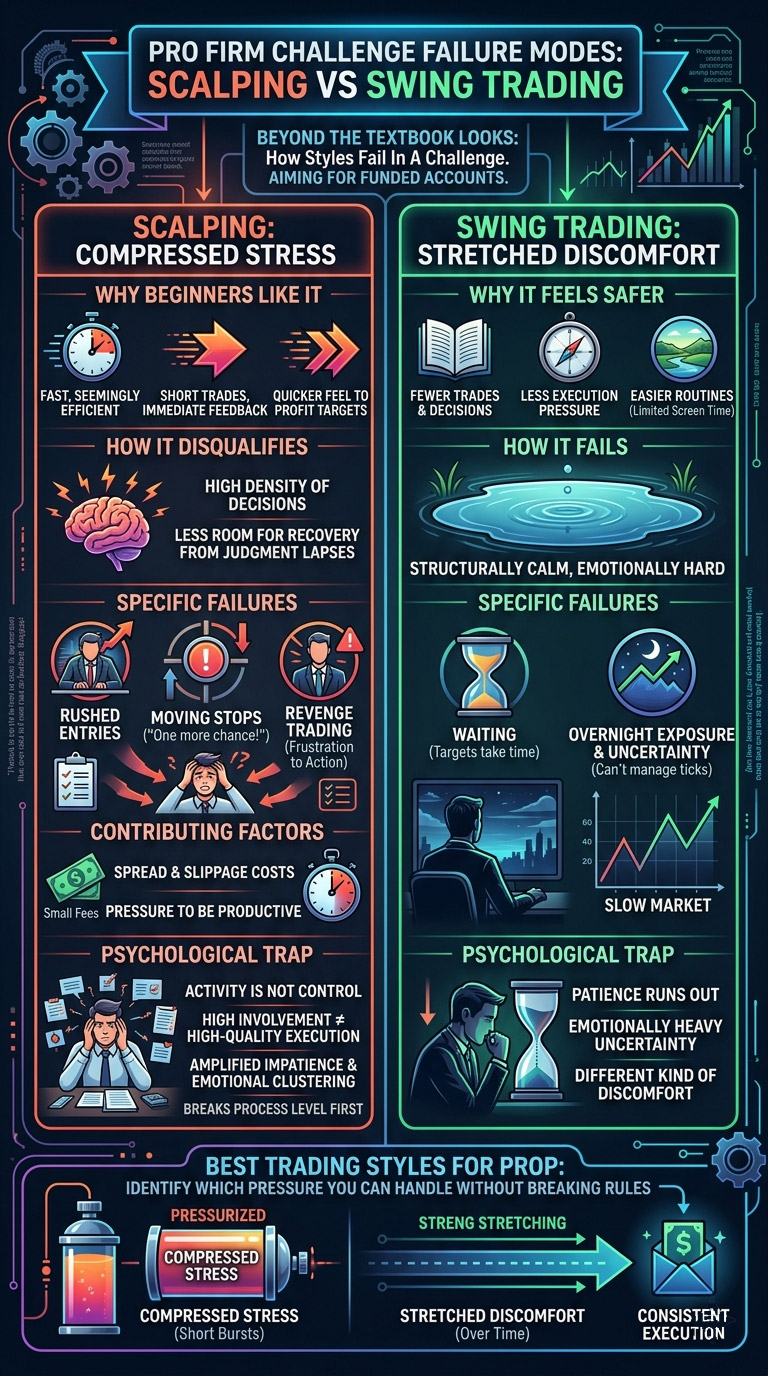
Why scalping can disqualify the Best Trading Styles for Prop for beginners
Scalping attracts beginners for an understandable reason: it looks efficient. The trades are short, the feedback is immediate, and the path to a profit target can feel faster than waiting days for a swing setup to develop. Inside a prop challenge, though, that speed changes the nature of the risk. Scalping does not usually fail because short-term trading is invalid. It fails because the style creates a high density of decisions, and every small lapse in judgment has less room to recover.
That is what makes scalping so unforgiving for beginners. A setup can be decent, but the entry is rushed. The stop is valid, but it gets moved because the trader wants one more chance. A scratch trade turns into a revenge trade because the pace of scalping leaves almost no time between frustration and action. Add spread, slippage, and the pressure to make the session feel productive, and the style starts punishing the trader before the strategy has even had a fair test.
There is also a psychological trap hidden inside the appeal of speed. Many beginners mistake activity for control. They feel productive because they are involved in the market constantly, but high involvement is not the same as high-quality execution. A scalper can be busy all session and still end the day with a rule problem, not because the market was impossible, but because the style amplified impatience and emotional clustering. That is why scalping often breaks a beginner at the process level first.
Why swing trading can make the Best Trading Styles for Prop feel slower but safer
Swing trading usually creates less execution pressure at the start. Fewer trades mean fewer decisions, more planning time, and less exposure to the small frictions that punish short-term trading. That alone makes swing trading feel more manageable for many beginners. It is also easier to build a routine around. A trader with limited screen time can review higher timeframes, plan levels, and avoid living inside every tick.
But swing trading has its own failure mode, and it is less obvious. Structurally, the style is calmer. Emotionally, it can be harder than it looks. A beginner may choose swing trading to avoid the pressure of rapid decisions, then discover a different kind of discomfort: waiting. Open trades move slowly. Targets take longer to reach. Overnight exposure introduces uncertainty the trader cannot manage minute by minute.
That is the key contrast beginners need to understand. Scalping usually fails when pressure is too high and mistakes multiply too quickly. Swing trading usually fails when patience runs out or overnight uncertainty becomes emotionally heavier than expected. One style compresses stress into short bursts. The other stretches discomfort over time. The Best Trading Styles for Prop are easier to identify once you ask which type of pressure you are more likely to handle without breaking your rules.
Best Trading Styles for Prop are really a choice between pressure and patience
For most beginners, the real choice is not simply scalping versus swing trading. It is pressure versus patience. The Best Trading Styles for Prop depend on which kind of discomfort the trader can handle cleanly and consistently. Not just how they analyze the charts on Tradingview.
Which beginner should delay chasing the Best Trading Styles for Prop through scalping
Most beginners do not struggle with scalping because they lack intelligence or effort. They struggle because scalping asks for a level of decision control they have not built yet. If a trader still needs constant market involvement to feel productive, still takes trades outside the plan because something is moving, or still finds it hard to stop after two losses, scalping usually turns those weaknesses into account damage very quickly.
This is why many new traders choose scalping for the wrong reason. They are not choosing it because it matches their edge. They are choosing it because it feels active. There is always another setup forming, another candle to react to, another chance to recover a loss before the session ends. That constant stimulation creates the illusion of opportunity, but in a prop challenge it often creates the more dangerous illusion of control.
The trader who should not scalp yet is usually easy to recognize. It is the trader who has not fully tested one repeatable setup. The trader who changes entry criteria depending on mood. The trader who can explain risk management after the session, but cannot follow it while the trade is live. It is also the trader with fragmented screen time. Scalping sounds flexible from the outside, but in practice it demands focused attention during the moments that matter.
Which beginner can still make the Best Trading Styles for Prop work with structure
That does not mean every beginner should avoid scalping. Some beginners come into prop trading with a more structured temperament than others. A trader who already follows a fixed routine, trades one or two well-defined intraday patterns, and is comfortable ending the day after a small, controlled result may still be a reasonable fit for lower-timeframe execution. The key difference is that this trader is not looking for action. They are looking for repetition.
Most beginners, though, are better suited to swing trading or at least lower-frequency execution. Not because swing trading is easy, but because it gives weaker habits less room to do immediate damage. A trader with a day job, limited screen time, or a tendency to overtrade under stress will usually make better decisions when the process slows down. Higher timeframes force selectivity. They make it harder to chase every small move and easier to think in terms of setup quality rather than market noise.
Some people cannot handle speed. Others cannot handle waiting. Some become reckless when they feel behind. Others become irrational when holding risk overnight. That is why the real choice is pressure versus patience. Scalping asks, “Can you stay precise under pressure?” Swing trading asks, “Can you stay patient without interfering?” For most first-time challenge takers, patience is the safer problem to solve.
Best Trading Styles for Prop improve when the challenge rules actually fit
Once the reader understands the pressure-versus-patience decision, the final question becomes more practical: which challenge structure quietly favors one style over the other? The Best Trading Styles for Prop can still fail if the account rules create friction in the wrong places. That is why a smart trader does not buy a challenge on price alone. The better move is to compare the rules, the payout logic, and the execution environment before committing.
Why the Best Trading Styles for Prop should be matched to the account you buy
The first thing to check is how drawdown is structured. A style that trades frequently can feel very different under a strict daily loss limit than under a roomier one. The second is time pressure. If a trader is naturally selective, an unlimited-time structure matters because it removes the urge to manufacture trades just to meet a deadline. The third is holding flexibility: can the trader hold through news, over the weekend, or across multiple sessions if that is part of the style? The fourth is tooling: are EAs allowed, and does the broker setup fit the way the trader executes?
This is also where PropLynq becomes relevant in a natural way. On its public pages, PropLynq presents four challenge paths: 1 step or 2 step prop firm challenge, Stellar Lite, and Instant Funding. It also states that traders use approved brokers under its BYOB approach, and that Stellar 2-Step, Stellar 1-Step, and Stellar Lite challenge phases have no time limit. Those details matter because they change whether slower and more selective trading has enough breathing room, or whether a faster trader can work inside an execution setup they already trust.
Why the Best Trading Styles for Prop need transparent rules and payout logic
The style-fit value becomes clearer when you look at the public rule language. On Stellar 2-Step, PropLynq lists an 8% phase-one target, 5% phase-two target, 5% daily loss limit, 10% max drawdown, 5 minimum trading days, leverage up to 1:100, and profit split from 80% up to 95%. PropLynq also states that all trading styles are allowed, including scalping and swing trading, and that news trading, weekend holding, and EAs or bots are allowed, while copy trading, latency arbitrage, excessive-risk martingale or grid tactics, account sharing, and certain hedging practices are restricted.
The payout side matters too. PropLynq’s public pages state that traders can withdraw through bank transfer, USDT, Wise, and Payoneer, that most payouts are processed within 24 hours, and that funded traders can scale to $4 million with profit splits up to 95%. That does not tell a trader which style to use, and it should not. What it does do is reinforce the right buying behavior: compare the challenge rules and the reward structure against the pace, holding style, and discipline you actually have.
If you want to compare the available models directly, you can compare PropLynq challenge types, review the PropLynq payout structure, and visit the PropLynq homepage before choosing a challenge. For beginners, that kind of rule-first comparison is much more useful than searching for a generic winner in the Best Trading Styles for Prop conversation.
Conclusion: Best Trading Styles for Prop depend on what you can execute cleanly
The comparison becomes much clearer once you stop asking which style sounds more exciting and start asking which style you can repeat inside a challenge account without damaging your own process. For beginners, the Best Trading Styles for Prop are usually not the styles that look fastest. They are the styles that create the least friction with the rules and the least damage to the trader’s own decision-making.
Scalping can work, but it usually asks for more precision, more emotional control, and more consistency under pressure than most new traders realize. Swing trading is rarely effortless, but it often gives beginners a cleaner environment to think, wait, and avoid turning one bad burst of execution into a rule breach. That is why the smarter move is not to chase the style that looks impressive. It is to choose the version of the Best Trading Styles for Prop that you can execute cleanly inside the rules you are actually buying.
FAQ about the Best Trading Styles for Prop
This FAQ block is written for on-page publishing and also supports the schema markup included in the SEO appendix.
What are the Best Trading Styles for Prop for complete beginners?
For most complete beginners, the Best Trading Styles for Prop are usually swing trading or lower-frequency intraday execution because they reduce decision speed, create more room for planning, and make overtrading less likely.
Is scalping one of the Best Trading Styles for Prop if I have a full-time job?
Usually not. If your market time is fragmented, scalping often becomes reactive instead of planned. In that case, the Best Trading Styles for Prop are usually slower approaches that fit your schedule and decision rhythm.
Why do the Best Trading Styles for Prop depend so much on drawdown rules?
Because challenge rules decide how much room your style has to breathe. A strategy that works in a personal account can become a poor fit if the daily loss limit or max drawdown is too tight for how it normally behaves.
Does PropLynq allow both scalping and swing trading?
On its public Trading Accounts page, PropLynq states that all trading styles are allowed, including scalping and swing trading, while certain abusive practices remain restricted.
What should I compare before buying a challenge?
Check the daily loss rule, max drawdown, minimum trading days, time limits, broker model, news and weekend holding permissions, and payout structure before you decide.
Miles Rowan Keene
As Senior Market Strategist at PropLynq, I write about market structure, trading psychology, and risk-first execution. My focus is on turning complex market behavior into clear, actionable lessons for both developing and experienced traders. I specialize in educational content covering funded account rules, drawdown management, trade planning, and strategy refinement, with the goal of helping traders build consistency through discipline, preparation, and a deeper understanding of how professional trading environments operate.
Weekly Trading Insights
Market analysis and trading tips delivered every Monday. No spam, unsubscribe anytime.


Comments
No comments yet — be the first.