1-Step vs. 2-Step prop firm challenge Explained

Choosing between a 1-step and 2-step prop firm evaluation sounds simple, but a 1-step vs 2-step prop firm challenge comparison becomes clearer only after you look past the headline. What matters more is the rule package behind the challenge: the profit target, daily loss limit, max drawdown, leverage, and the amount of pressure you feel while trying to pass. PropLynq offers both Stellar 1-Step and Stellar 2-Step, which makes it a useful real-world example for explaining how these account types differ in practice.
A 1-step evaluation gives you one phase to qualify for funding. A 2-step evaluation makes you pass two separate phases, usually with the goal of testing both performance and consistency. On PropLynq, the one-step route is shorter, but it runs inside tighter risk limits. The two-step route takes longer, but it gives more room on daily loss, max drawdown, and leverage. That trade-off is what beginner traders actually need to understand before buying a challenge.
1 step vs 2 step prop firm challenge: the short answer
A 1-step prop firm challenge is usually built for traders who want a more direct route to funding. At PropLynq, Stellar 1-Step is listed as a one-phase challenge with a 10% target, 3% daily loss limit, 6% max drawdown, 1:30 leverage, 2 minimum trading days, and unlimited time.
A 2-step prop firm challenge is usually built for traders who want more room to trade, even if that means proving themselves over two phases instead of one. At PropLynq, Stellar 2-Step is listed with an 8% phase-1 target, 5% phase-2 target, 5% daily loss limit, 10% max drawdown, 1:100 leverage, 5 minimum trading days, and unlimited time.
So the short answer in any 1-step vs 2-step prop firm challenge comparison is this: 1-step is faster on paper, while 2-step is roomier on paper. For beginners, the better option usually depends less on the number of phases and more on whether the risk limits match the way they already trade. That final judgment is an editorial conclusion based on PropLynq’s published rule differences.
What a 1-Step Evaluation Looks Like at PropLynq
In a 1-step vs 2-step prop firm challenge comparison, PropLynq’s Stellar 1-Step is the single-phase option. In the comparison table, it is shown with a 10% phase target, 3% daily loss limit, 6% max drawdown, 1:30 leverage, 2 minimum trading days, unlimited time, and an 80%→95% profit split. The same comparison area shows that news trading, weekend holding, and EAs / bots are allowed.
That structure makes the appeal obvious. There is only one phase to clear, so the route to a funded account feels more direct. For a beginner, that can sound simpler than passing two separate phases. But the tighter risk box changes the difficulty. A one-phase model does not automatically mean an easier model. With only 3% daily loss and 6% max drawdown, the one-step format leaves less room for oversized positions, emotional trading, or sloppy risk control. That interpretation is an editorial inference from the published limits.
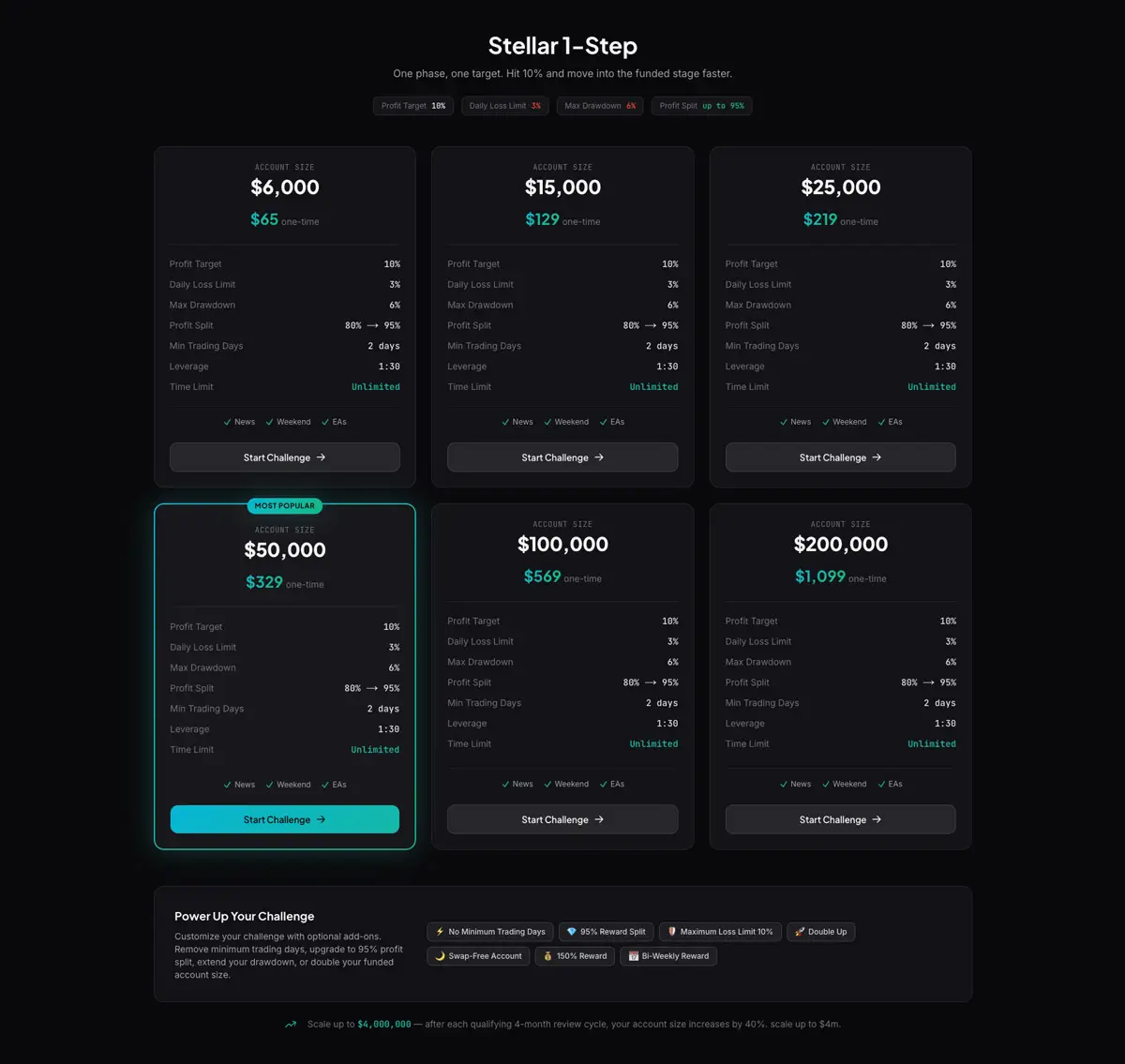
In a 1-step vs 2-step prop firm challenge comparison, the 2 minimum trading days requirement also matters. It means the account is not built around a long waiting period, and the unlimited time rule removes deadline pressure. But unlimited time does not weaken the risk rules. It only means the challenge does not expire while you work toward the target.
What a 2-Step Evaluation Looks Like at PropLynq
Within a 1-step vs 2-step prop firm challenge breakdown, PropLynq presents Stellar 2-Step as its most popular challenge and describes it as a two-phase path to prove consistency before funding. The trading accounts page lists it with 8% for phase 1, 5% for phase 2, 5% daily loss, 10% max drawdown, 1:100 leverage, 5 minimum trading days, unlimited time, and an 80%→95% profit split.
For beginners, the biggest appeal of a 2-step model is not speed. It is breathing room. Compared with PropLynq’s 1-Step structure, the 2-Step account gives more room on both daily loss and maximum drawdown, while also offering higher leverage. That does not make it automatically easier, but it can make the account feel less restrictive for strategies that need more normal price movement before the setup works. That “breathing room” point is an editorial inference from PropLynq’s published rules.
That trade-off is central to any 1-step vs 2-step prop firm challenge decision because you must pass two separate targets. PropLynq’s evaluation rules page lays out the structure clearly: 8% in phase 1, 5% in phase 2, with the same daily loss and drawdown framework and 5 minimum trading days. After phase 2 is completed, the trader moves to funding.
1-step vs 2-step prop firm challenge: the differences that matter most
The first difference is speed to funding. A 1-step account is naturally shorter because there is only one target to hit. At PropLynq, that means one phase at 10% instead of two phases at 8% and 5%. For a trader who can stay precise inside tighter limits, that makes 1-Step the more direct route.
The second difference in a 1-step vs 2-step prop firm challenge comparison is drawdown room. PropLynq shows 3% daily loss and 6% max drawdown on 1-Step versus 5% daily loss and 10% max drawdown on 2-Step. For beginners, this can matter more than the phase count because it affects how much normal market movement the account can absorb before a rule breach.
The third difference is leverage. PropLynq lists 1:30 leverage on 1-Step and 1:100 leverage on 2-Step. Higher leverage is not automatically better, but it does give more flexibility in position sizing. For traders who are still learning discipline, that can be either helpful or dangerous, depending on how well they control risk. The leverage figures are factual; the caution is editorial.
The fourth difference in a 1-step vs 2-step prop firm challenge analysis is psychological pressure. The 1-Step model creates pressure through a tighter rule box. The 2-Step model creates pressure through a longer process. Some traders prefer the urgency of one phase. Others perform better when the structure gives them more room, even if they must prove themselves twice. That comparison is an editorial inference from the published rules.
Which one is better for beginner traders?
For most beginners, the better 1-step vs 2-step prop firm challenge option is the one that allows them to execute a simple strategy without forcing bad habits. Based on PropLynq’s published numbers, the 2-Step model looks more forgiving on risk limits, while the 1-Step model looks more direct but tighter.
That is why “better for beginners” does not automatically mean “fewer steps.” A beginner who is still learning position sizing, patience, and emotional control may find the 2-Step format easier to manage because it provides more room on drawdown and leverage. A beginner who already trades with tight control and does not need much leverage may prefer the 1-Step path because it removes the second phase and only requires 2 trading days. That fit judgment is editorial, based on PropLynq’s published structure.
One extra layer matters in any 1-step vs 2-step prop firm challenge comparison: PropLynq says its drawdown framework is equity-based, not just balance-based, and that both floating and realized P&L count. That means tighter-loss accounts can feel harder in live execution than they look in a feature table, especially for beginners who hold trades through temporary drawdown.
1-step vs 2-step prop firm challenge rule details traders often miss
When traders compare a 1-step vs 2-step prop firm challenge, they often focus on the headline numbers and skip the mechanics underneath. On PropLynq’s evaluation rules page, the firm says every rule is public and measurable. It also explains that daily drawdown is measured from equity at the start of the day, not only from closed balance, and that both floating and realized P&L count because the model is equity-based.
The next detail beginners often miss is minimum trading days. On PropLynq, 1-Step requires 2 days while 2-Step requires 5 days. That means a trader cannot assume a quick target hit is enough by itself; the account still has to satisfy the minimum-day condition unless an add-on changes that requirement. PropLynq also advertises optional add-ons like removing minimum trading days, upgrading to a 95% reward split, extending drawdown, and doubling funded account size.
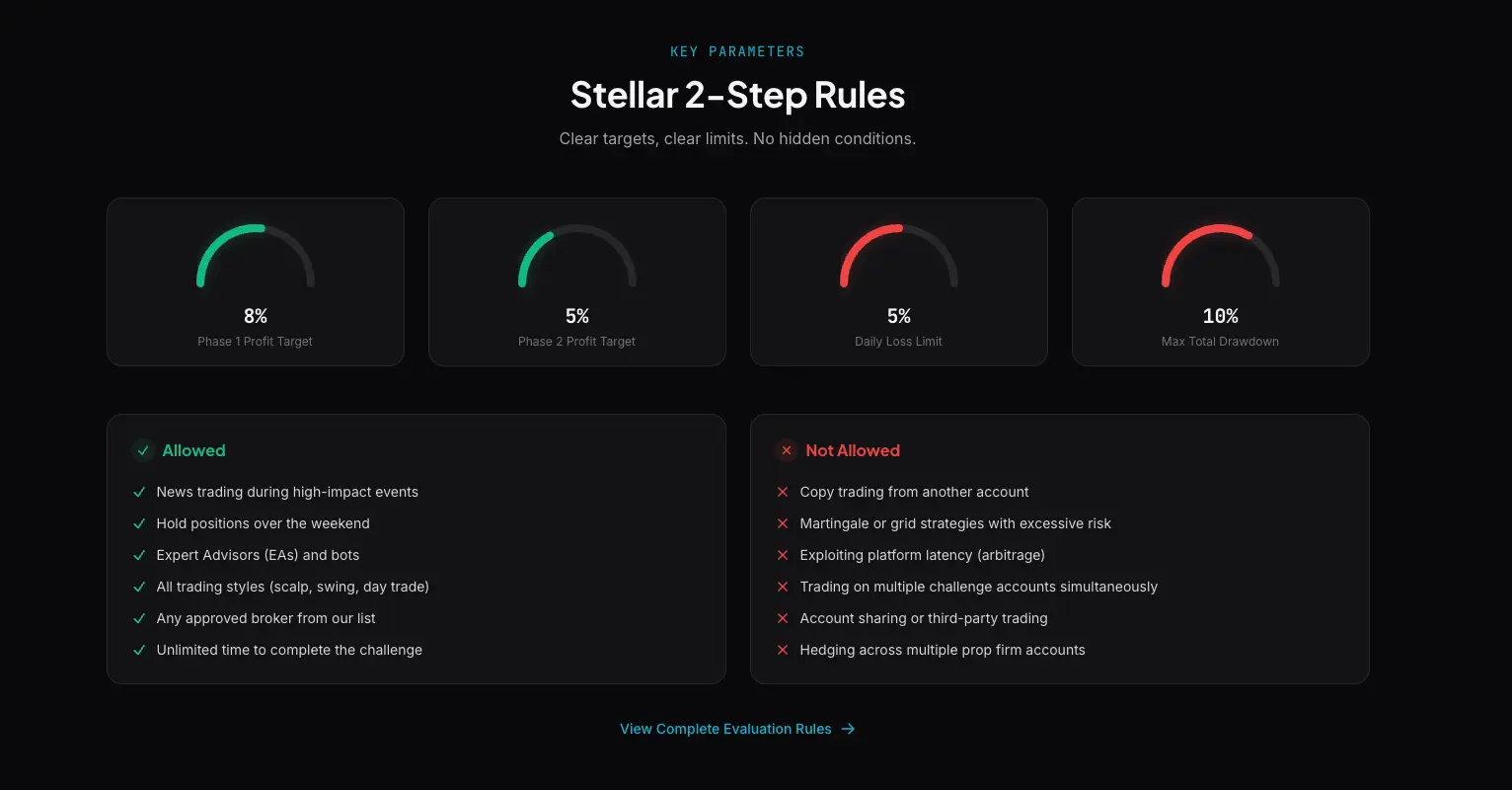
Another overlooked point is the difference between flexibility and anything-goes trading. PropLynq states that news trading, weekend holding, EAs, and multiple trading styles are allowed, but its comparison and rules pages also list restrictions such as copy trading from another account, excessive martingale or grid strategies, platform-latency exploitation, account sharing, and cross-firm hedging.
The final point many beginners miss in a 1-step vs 2-step prop firm challenge review is the business model itself. PropLynq’s risk disclosure says challenge accounts run in a simulated trading environment, that buying a challenge does not mean opening a brokerage account with PropLynq, and that the firm’s monitoring access is read-only under its BYOB model. The risk disclosure also states that challenge fees are non-refundable once trading has commenced, that many traders do not pass, and that purchasing a challenge does not guarantee funding or profitability.
How to Compare More Than Just the Evaluation
Once you understand the evaluation rules, the smarter move in any 1-step vs 2-step prop firm challenge comparison is to compare the rest of the setup too. PropLynq’s bring-your-own-broker model means traders choose from approved brokers, connect their own MT5 account, and let PropLynq monitor activity through a read-only connection. The how-it-works page says this monitoring cannot place trades, modify orders, or withdraw funds.
PropLynq also says traders can use instruments available at their chosen broker, including forex pairs, indices, metals, energies, and crypto CFDs, and that EAs and algorithmic trading are allowed on most challenge types. For beginners, that matters because broker fit and instrument access can be just as important as the evaluation model itself.
Then there is the payout structure. PropLynq says funded traders can keep up to 95% as they scale, and its how-it-works FAQ says Stellar 1-Step rewards are available every 5 business days, while Stellar 2-Step rewards start after 21 days and continue every 14 days. The payouts page also advertises a 24-hour processing guarantee, 85+ countries served, multiple withdrawal methods, and zero fees.
Finally, PropLynq says funded traders can scale accounts up to $4,000,000, and both the homepage and how-it-works page repeat that scaling and up to 95% reward language. For a beginner, that means the decision should not stop at “Which challenge is easier to pass?” It should also include “Which challenge makes the most sense if I actually stay funded and grow?”
A Simple Checklist Before You Choose
Before buying a challenge, ask these five questions.
Can I hit the target without forcing trades? If your setup needs more time and more price movement, the tighter 1-Step limits may feel restrictive. If your entries are already selective and controlled, the shorter one-phase route may suit you. The underlying numbers come from PropLynq’s comparison table; the fit judgment is editorial.
Can I manage equity-based drawdown in real time? PropLynq says floating and realized P&L both count, so open trades can affect your loss limits before you close them.
Does leverage help my strategy, or would it tempt me into overtrading? PropLynq publishes 1:30 on 1-Step and 1:100 on 2-Step. Higher leverage can create flexibility, but it can also magnify weak discipline.
Do I care more about a shorter path or a more forgiving structure? 1-Step removes the second phase and only needs 2 days. 2-Step takes longer but offers more room on risk limits and leverage.
Have I checked payouts, not just the evaluation? PropLynq’s payouts page promotes a 24-hour processing guarantee, zero fees, and multiple payout methods, while its how-it-works page explains that reward timing varies by model.
Final Takeaway
For beginner traders, the choice between a 1-step and 2-step evaluation is really a choice between speed and tighter control on one side, and more structure with more room on the risk limits on the other. On PropLynq.com , Stellar 1-Step is the more direct route, while Stellar 2-Step offers more room on drawdown and leverage but asks you to prove yourself over two phases.
That means the better option is not the one with the cleaner headline. It is the one that fits the way you already trade. If your edge depends on precision and tight control, 1-Step may fit better. If you want more room to manage variance and you do not mind a longer evaluation, 2-Step may be the stronger choice. That final guidance is editorial, built on PropLynq’s published rules and risk disclosures.
The practical next step is simple: compare the challenge structures side by side, then review the payout setup before committing. That gives you a more complete decision than choosing based on phase count alone.
Miles Rowan Keene
As Senior Market Strategist at PropLynq, I write about market structure, trading psychology, and risk-first execution. My focus is on turning complex market behavior into clear, actionable lessons for both developing and experienced traders. I specialize in educational content covering funded account rules, drawdown management, trade planning, and strategy refinement, with the goal of helping traders build consistency through discipline, preparation, and a deeper understanding of how professional trading environments operate.
Weekly Trading Insights
Market analysis and trading tips delivered every Monday. No spam, unsubscribe anytime.


Comments
No comments yet — be the first.