Static vs Trailing Drawdown: What Funded Traders Need to Know

Most traders do not fail a funded challenge because they picked the wrong profit target. They fail because they misunderstood the rule that decides when the account is done. That is why static vs trailing drawdown matters more than many beginners realize. Two firms can advertise similar percentages, but the actual pressure on your trading can feel completely different once open profit, floating loss, and new equity highs start changing the room you have left. Static drawdown stays fixed. Trailing drawdown moves as the account reaches new peaks, and that changes how aggressively you can press trades or how much profit you can afford to give back. The confusion around static vs trailing drawdown is not academic. It affects position sizing, trade management, and whether a strategy that looks fine on paper is actually survivable inside a challenge.
Static vs trailing drawdown: the short answer
Static drawdown is a fixed loss floor, usually anchored to the starting balance. If the account is allowed a $5,000 maximum drawdown on a $50,000 account, that breach line stays in the same place unless the firm’s rules say otherwise. Trailing drawdown is different. The loss floor moves up as the account reaches new balance or equity highs, which means your room can shrink even while you are making progress.
That is the real answer to static vs trailing drawdown: static gives you a stable floor to work above, while trailing keeps ratcheting the floor upward as you perform. Static often feels easier to manage for traders who need normal price movement and some profit giveback. Trailing can reward discipline, but it can also punish loose trade management, especially when the rule is tied to equity rather than closed balance. Not every trailing rule works the same way, so the exact wording matters.
What a fixed loss floor actually means
Static drawdown is the simpler structure to understand because the breach level does not chase your profits. The firm sets a maximum total loss from the opening balance, and that floor stays fixed. On a $50,000 account with a 10% static max drawdown, the key line is $45,000. Whether you are flat, up $1,500, or up $4,000, the rule is still anchored to that original threshold. That gives traders a cleaner way to think about risk: the buffer between current equity and the fixed floor grows as profits accumulate.
That does not mean static drawdown is loose or forgiving in every situation. A trader can still fail quickly by oversizing, stacking correlated positions, or ignoring daily loss rules. But static does remove one source of pressure that trailing models create: you are not watching the maximum-loss line rise every time the account makes a new high. For many traders, especially those who hold for larger intraday swings or allow trades time to develop, that fixed reference point makes execution easier to plan.
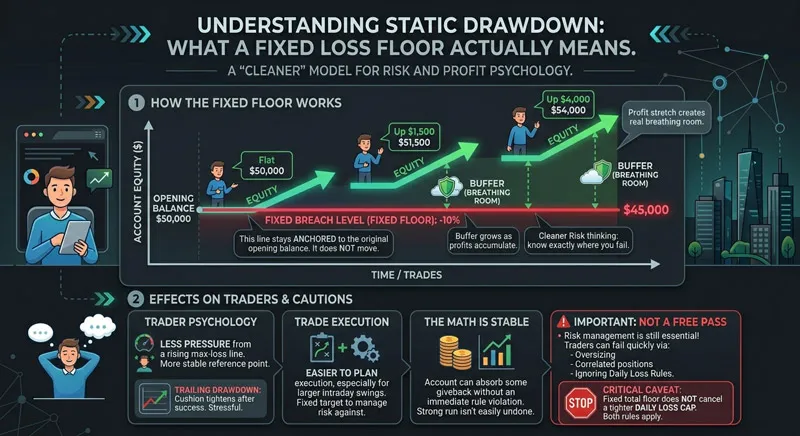
It also changes the psychology of profit. Under a static structure, a winning stretch usually creates more real breathing room instead of simply dragging the breach line upward behind you. That is why traders often describe static vs trailing drawdown as a choice between a cushion that grows and a cushion that can tighten after success. The math is more stable, and the account can absorb some giveback without turning a strong run into an immediate rules problem. The catch is simple: static drawdown still needs to be read alongside the daily loss rule, because a fixed total floor does not cancel a tighter daily cap.
Why a moving loss floor changes execution
Trailing drawdown is the rule that catches traders who assume profits automatically create safety. Instead of leaving the loss floor fixed at the starting balance, trailing drawdown pushes that floor upward whenever the account reaches a new high. The basic formula is simple: highest balance or equity reached, minus the allowed drawdown amount. Once that line moves higher, it usually does not come back down after losses. That is why traders often describe trailing drawdown as a moving stop on the whole account rather than on one position.
The detail that matters most is what the firm is trailing. Some firms trail closed balance only. Others trail real-time equity, which includes floating profit and floating loss. Equity-based trailing is tighter because open profit can lift the high-water mark before the trade is closed. If that trade reverses, the trader may discover that the account is much closer to the breach line than it looked a few minutes earlier.
That is also why trailing drawdown changes trade management. It rewards consistency, but it can punish traders who let open winners swing too far back, pyramid too aggressively, or assume that unrealized profit is harmless until the position is closed. Under a static structure, early profits usually widen the cushion. Under a trailing structure, early profits can shrink the room left between current equity and the kill switch. In practical terms, static vs trailing drawdown is often a question of how much giveback your method can tolerate. The rule is not automatically bad, but it is less forgiving of sloppy execution and much more sensitive to how the firm defines the calculation.
- Static drawdown stays anchored to the starting balance.
- Trailing drawdown ratchets upward when the account hits new highs.
- Balance-based trailing is usually easier to track than equity-based trailing.
- Floating P&L can matter before a trade is closed if the rule is equity-based.
Static vs trailing drawdown comparison table
A side-by-side view makes the real difference easier to see in static vs trailing drawdown. The headline percentage alone rarely tells the full story. What matters is whether the breach line stays fixed or climbs with performance.
| Feature | Static drawdown | Trailing drawdown |
|---|---|---|
| Reference point | Starting balance | Highest balance or equity reached |
| Does the loss floor move? | No, it stays fixed | Yes, it ratchets upward with new highs |
| What happens after profits? | Your cushion usually grows | Your breach line often moves closer |
| Tracking difficulty | Simpler | Higher, especially if equity-based |
| Open-trade sensitivity | Depends on firm rules, but usually less punishing structurally | Can be very sensitive if floating equity is included |
| Best fit tendency | Traders who need room for normal pullback and trade development | Traders who keep risk tight and manage profit giveback aggressively |
The simplest way to read this table is to ask one question: does my strategy need breathing room after I make progress, or can I live with a floor that rises behind me? That answer usually matters more than the marketing language around the account.
A $50,000 example: same P&L, different drawdown outcome
Assume two traders each start with a $50,000 account and a $5,000 maximum loss allowance. This is where static vs trailing drawdown becomes expensive. On the static account, the hard floor is $45,000 and it stays there. On the trailing account, the floor starts at $45,000 too, but it moves up whenever the account prints a new high. The traders follow the same path.
First, both traders make $3,000. Their account reaches $53,000. On the static account, the loss floor is still $45,000, so there is now $8,000 of room between current balance and the breach line. On the trailing account, the floor ratchets up to $48,000 because the allowed loss still trails by $5,000 from the new high. The trader feels ahead, but the usable cushion is smaller than it looks.
Next, both traders give back $4,500 during a rough stretch. Their account drops to $48,500. The static account is still alive with $3,500 of room left before breach. The trailing account is now only $500 above the line. One more normal pullback, one spread spike, or one stubborn hold can end the challenge.
Now imagine the trader briefly hits $54,200 in open equity before closing lower. On an equity-based trailing model, that temporary high can pull the floor up again even if the final closed balance does not hold the move. That is the part traders miss. The same P&L path can feel manageable under static drawdown and much tighter under trailing drawdown because the rule itself changes the room available after success.
Which traders usually fit static vs trailing drawdown?
There is no universal winner in static vs trailing drawdown. The better structure is usually the one that matches how your strategy behaves after it goes into profit. Traders who need positions to breathe often prefer a fixed floor. Traders who cut quickly, protect open gains fast, and rarely tolerate deep pullbacks may be more comfortable with a moving one.
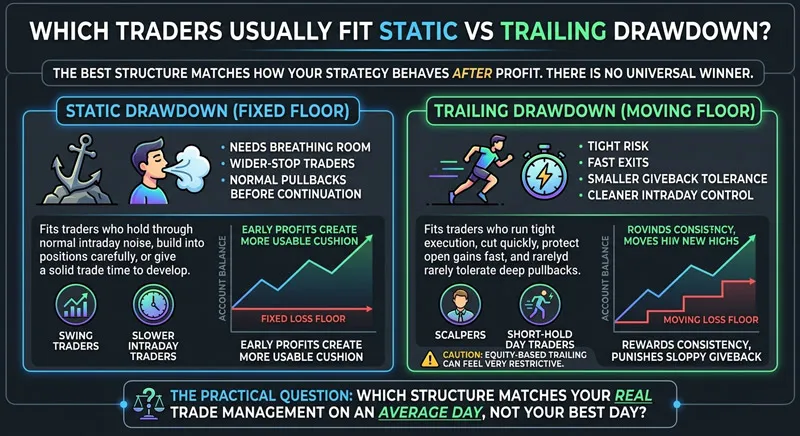
Static drawdown usually fits traders who hold through normal intraday noise, build into positions carefully, or give a solid trade time to develop. Swing traders and slower intraday traders often value the fact that early profits create more usable cushion instead of dragging the account-level loss floor upward. That does not make static easy. It just makes the risk envelope easier to read.
Trailing drawdown usually fits traders who already run tight execution. Scalpers, short-hold day traders, and traders who actively defend open equity may find it workable because the rule rewards consistency and punishes sloppy giveback. But this is the catch: if your style depends on watching an open winner float, pull back, and then continue, trailing can feel restrictive very quickly, especially when the rule is based on equity rather than closed balance.
- Static drawdown tends to fit: traders who need breathing room after gains, wider-stop traders, and strategies with normal pullback before continuation.
- Trailing drawdown tends to fit: traders with tight risk, fast exits, smaller giveback tolerance, and cleaner intraday control.
The practical question is not which rule sounds easier in marketing. In static vs trailing drawdown, ask which structure matches your real trade management on an average day, not your best day.
How PropLynq account types map to each rule
On PropLynq’s live comparison table, the split is fairly clear. For PropLynq readers, static vs trailing drawdown is visible in the product mix, not just in theory. Stellar 2-Step is listed with a 5% daily loss limit and 10% max drawdown. Stellar 1-Step is listed with a 3% daily loss limit and 6% max drawdown. The same table also shows Stellar Lite at 4% daily loss and 8% max drawdown, while Instant Funding is shown with no daily loss limit and a 6% trail. Inside PropLynq, static vs trailing drawdown is not an abstract distinction. The evaluation-style accounts use fixed maximum-drawdown language, while Instant Funding is the program explicitly labeled as trailing.
The public published evaluation rules make the fixed-side wording more concrete. PropLynq says total drawdown is calculated from the initial starting balance. It also says daily drawdown is measured from equity at the start of each trading day at 00:00 UTC, and that both floating and realized P&L count. That matters because a trader can have a fixed total drawdown structure while still being monitored with equity-based daily-loss logic.
For readers comparing account types, the practical move is to compare PropLynq challenge types first, then read the exact rule wording. The plan table tells you which structure you are likely dealing with. The rules page tells you how tightly that structure is enforced in real trading conditions. If you want the full setup and broker-monitoring context, how PropLynq works also confirms the BYOB model, 10+ approved brokers, read-only MT5 investor-password monitoring, and unlimited time across Stellar challenge phases.
Decision checklist before you buy a funded challenge
Before you pay for any account, run through this checklist. Most confusion around static vs trailing drawdown comes from traders reading the percentage and skipping the calculation method. If a firm cannot explain this clearly, static vs trailing drawdown is exactly where the hidden friction usually sits.
- Is the max loss floor fixed from the starting balance, or does it trail behind new highs?
- Does the firm calculate the rule from balance or equity?
- Do floating profits and floating losses count before trades are closed?
- Is there also a separate daily loss rule that can breach the account sooner?
- If the rule trails, does it stop at breakeven or keep moving under specific conditions?
- How does the rule fit your real trade style: wider holds, quick scalps, or something in between?
- What happens after you get funded, and how do payouts work once you are consistent?
That last point matters more than many traders expect. A challenge is not just about passing. It is about whether the rule set still makes sense after funding. On PropLynq’s live pages, the payout structure is public: the site shows a $50 minimum withdrawal, multiple withdrawal methods, zero fees, and a 24-hour processing guarantee on the payout schedule and methods page.
If a firm answers these questions clearly, you are dealing with a rules page worth trusting. If the wording stays vague, assume the rule will feel worse in practice than it looks in marketing.
Final takeaway on static vs trailing drawdown
The cleanest way to think about static vs trailing drawdown is this: static keeps the loss floor fixed, while trailing keeps moving it upward as the account makes new highs. Neither rule is automatically better. The better rule is the one your strategy can survive without forcing bad trade management.
For most traders, the safest move is to stop comparing headline percentages and start reading the calculation method. Check whether the rule is based on balance or equity, whether floating P&L counts, and whether the account uses a fixed max-drawdown model or a trail. That is where static vs trailing drawdown becomes a real trading decision instead of a marketing label.
If you are comparing live account options, start with the rule wording, then confirm the plan structure and payout details before you buy.
Miles Rowan Keene
As Senior Market Strategist at PropLynq, I write about market structure, trading psychology, and risk-first execution. My focus is on turning complex market behavior into clear, actionable lessons for both developing and experienced traders. I specialize in educational content covering funded account rules, drawdown management, trade planning, and strategy refinement, with the goal of helping traders build consistency through discipline, preparation, and a deeper understanding of how professional trading environments operate.
Weekly Trading Insights
Market analysis and trading tips delivered every Monday. No spam, unsubscribe anytime.


Comments
No comments yet — be the first.