How to Trade Forex News in 2026

NFP drops: 256,000 jobs added. The forecast was 189,000. By any standard, that’s a bullish print for the dollar. You buy USDJPY the moment the number hits. The pair spikes 45 pips — you’re in profit. Then over the next four minutes it reverses entirely, down 90 pips from your entry. Stop taken out. Loss booked. Forty minutes later, USDJPY is trading right back where it was before the release. This is actually what it feels like if you want to know how to trade forex news in 2026.
You read the number correctly. The economic logic was sound. You still lost.
This is the central failure mode in forex news trading, and it happens to beginners and experienced traders alike. The problem isn’t your analysis. The problem is the premise: most traders approach news events by trading the number, when the market is actually trading the deviation from the expected number. Those aren’t the same thing — and sometimes they move in opposite directions.
This guide covers how to trade forex news events with a clear framework: what the market is actually pricing in when a release hits, which economic releases consistently produce directional volatility, how to read an economic calendar for the signal that matters, and three practical approaches for entering trades without walking into an institutional exit.
Why Most Traders Get Forex News Trading Backwards
Every major economic release comes with three numbers: the previous reading, the forecast, and the actual. Most traders stare at the actual. Good number equals buy. Bad number equals sell. Logical, intuitive, and consistently unprofitable.
By the time data lands on your screen, institutional traders have already positioned based on their own internal models, related leading indicators, and the collective drift of market expectations — sometimes called the “whisper number” — built up in the days before the release. NFP has the ADP employment report two days earlier. CPI has PPI as a leading signal. Interest rate decisions are telegraphed through central bank speeches across a full meeting cycle.
What institutional traders are waiting for isn’t confirmation of what they expected. They’re waiting to see how the actual compares to that expectation. A large positive surprise triggers new buying. A large negative surprise triggers selling. A number that simply meets the forecast — even a strong number — often produces a muted reaction or an outright reversal, as traders who positioned ahead of the release close those positions into the liquidity the announcement creates.
The deviation is the signal. Actual minus Forecast equals the market’s trigger.
A +67,000 surprise on NFP (256K actual versus 189K forecast) is a genuine bullish shock to USD. A +5,000 beat barely registers. And a number that exactly matches the consensus can reverse sharply, because nothing new entered the market — the move was already in, and the data simply confirmed what was priced.
This one principle separates traders who profit from forex news trading from those who consistently take stops on the “correct” directional trade. Understanding it before you enter any news position is not optional — it’s the entire foundation.
Traders applying forex news trading strategies inside a prop trading environment face an additional layer: news volatility can deplete a daily drawdown limit in a single candle. That dynamic is addressed specifically in the prop firm section below.
The News Releases That Move Forex Markets Most
Not every item on the economic calendar deserves a strategy. Some releases consistently produce clean, directional volatility. Most produce noise. Knowing the difference is the first filter in any forex news trading approach.
Non-Farm Payrolls (NFP) is the most closely watched economic release in the forex market. Published on the first Friday of each month at 8:30 AM ET, it measures U.S. job creation outside the agricultural sector. On a large surprise, EUR/USD and USD/JPY regularly move 80–150 pips within the first few minutes. NFP matters because employment data feeds directly into Federal Reserve rate expectations, and rate expectations drive dollar positioning more than almost any other variable.
CPI (Consumer Price Index) data from major economies — U.S., Eurozone, U.K., Japan — moves their respective currencies because it shapes central bank rate decisions. A higher-than-expected CPI print typically strengthens the currency, but as the analysis behind why the CPI reaction often contradicts the headline number shows, the actual direction depends on whether rate hikes are already priced in. When they are, a hot inflation print can produce a reversal rather than a rally.
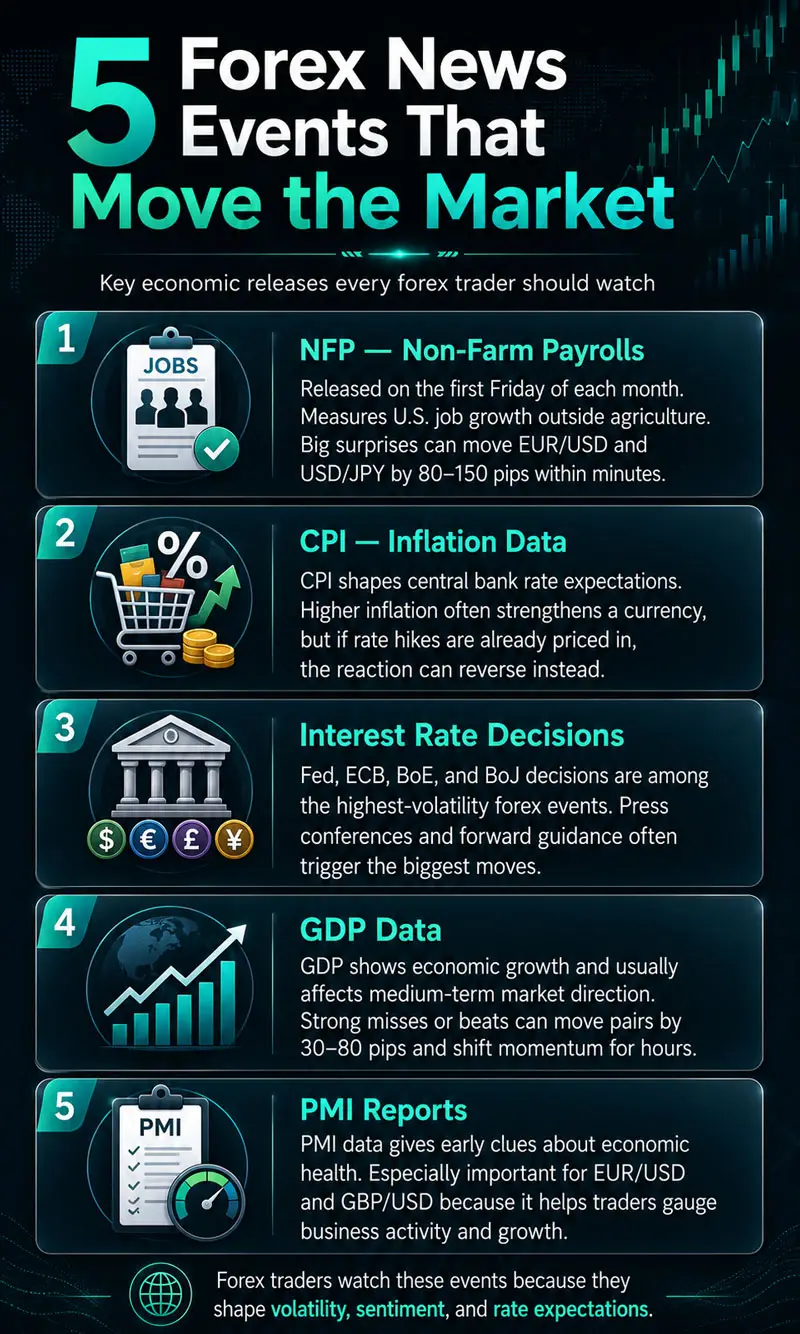
Interest rate decisions from the Federal Reserve, European Central Bank, Bank of England, and Bank of Japan are the highest-volatility events in the forex calendar. Moves of 80–200 pips or more are common on the currency pairs involved. True surprises are rare — central banks communicate extensively beforehand — but the accompanying press conferences and forward guidance statements often drive the largest intraday moves as traders reprice rate paths in real time.
GDP figures affect medium-term positioning. Moves are typically smaller (30–80 pips on a significant miss or beat) but can shift momentum for hours. PMI data — manufacturing and services health readings — gives early signals on economic direction and is particularly relevant for EUR/USD (Eurozone and German PMI) and GBP/USD (U.K. PMI).
The pairs that react most consistently to news are the major USD crosses: EUR/USD, GBP/USD, USD/JPY, and USD/CAD. Understanding which currency pairs respond most sharply to specific releases lets you select the highest-volatility instrument for each event rather than defaulting to the same pair out of habit.
| News Release | Primary Currency | Typical Pip Range (Large Surprise) | Release Schedule |
|---|---|---|---|
| Non-Farm Payrolls (NFP) | USD | 80–150+ pips | First Friday of month, 8:30 AM ET |
| CPI (Inflation Data) | USD / EUR / GBP | 50–120 pips | Monthly, varies by country |
| Interest Rate Decision | Currency of central bank | 80–200+ pips | 6–8 times per year |
| GDP | USD and others | 30–80 pips | Quarterly |
| PMI | EUR / GBP | 20–60 pips | Monthly |
Focus your forex news trading strategy on the top three rows. GDP and PMI are worth monitoring, but rarely justify a specific entry plan unless you are actively managing macro positions with longer holding periods.
How to Read an Economic Calendar Before You Trade Forex News
Every major economic calendar — Forex Factory, Investing.com, TradingView — shows the same three columns for each scheduled release: Previous, Forecast, and Actual.
Previous is historical context. Forecast is what the market has already priced in. Actual is what just happened. The only number that generates new price movement is the gap between Forecast and Actual. This is the column to watch.
A concrete example: NFP Forecast is 175K. Actual comes in at 234K. The +59K positive surprise is a USD-bullish shock. EUR/USD sells off. USD/JPY rallies. The headline number is strong, but what matters is that it was meaningfully stronger than expected.
The opposite: CPI Forecast is 3.2%. Actual prints 3.2%. No deviation. The pair may spike briefly as algorithms react to the release timestamp, then reverses. Traders who positioned ahead of the print close those positions. The currency weakens even though the inflation number was above the central bank’s target — because nothing new entered the market.
Deviation size matters too. On NFP, a +10K surprise rarely sustains a directional move. A +50K surprise almost always does. Knowing the historical range of surprises for a given release helps calibrate your position size and stop width.
Economic calendars use impact ratings to flag which releases to focus on:
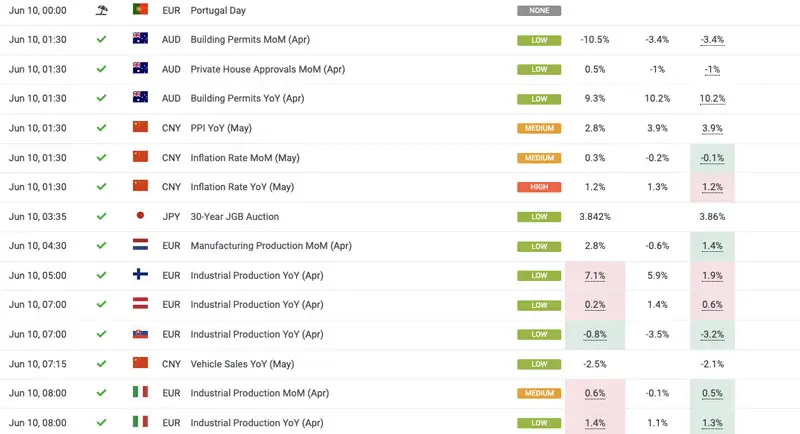
- Red (High Impact): Can move markets significantly. Plan your approach in advance or close positions in the affected pair before the release window.
- Orange (Medium Impact): Limited directional effect in most cases. Be aware of direction but a full strategy is rarely warranted.
- Yellow (Low Impact): Generally safe to hold positions through without adjustment.
For any forex news trading approach, red events are the only releases that require a pre-planned strategy. Filter your calendar to high-impact events before each session and treat everything else as background information.
A good prop firm challenge dashboard integrates upcoming high-impact events into your session monitoring view. If yours does not, bookmark Forex Factory and check it before opening any position — not after.
Three Approaches to Entering a Forex News Trade
There is no single correct method for how to trade forex news events. The right approach depends on your risk tolerance, familiarity with the specific release, and whether you can be at your screen when the number drops. These three approaches cover the realistic range from highest to lowest execution difficulty.
1. Pre-News Positioning
You form a directional view before the release — based on ADP data, preliminary figures, central bank tone — and enter in advance. If the data confirms your view with a large surprise, you capture the full directional move from a favorable entry, often 10–20 pips better than post-release traders get.
The execution risk is significant. If the number surprises in the other direction, you are immediately offside, and your broker’s spread may have already widened 5–10 times its normal level before you can exit. Pre-news positioning is for traders with clear macroeconomic conviction and comfortable wider stops. It is not a starting point for learning how to trade forex news.
2. The Wait-and-See (Post-Spike Continuation)
This is the most consistently executable forex news trading approach. After the release, let the initial volatility run for 5–15 minutes. Once the spike settles and a clear directional structure is forming — a pullback to a prior level, a rejection, a continuation signal — enter in the direction of the news move.
Here is how it played out for one trader on a major NFP release:
Marco was watching EUR/USD on NFP Friday. Forecast: 175K. Actual: 256K — a strong positive surprise for USD. EUR/USD dropped from 1.0855 to 1.0775 in the first 90 seconds. Marco waited. Nine minutes after the release, EUR/USD retraced to 1.0805 — a prior support level, now acting as resistance. A bearish rejection candle formed at that level. Marco entered short at 1.0802, stop at 1.0835 (33 pips of risk), target at 1.0720 (82 pips). Risk-reward: 1:2.5. The trade reached target within three hours.
The wait-and-see approach keeps you out of the worst spread conditions and eliminates most fake reversals. Using Fibonacci retracement levels to identify where the pullback might stall, and looking for a break of structure as entry confirmation, adds technical precision to what is otherwise a timing-based approach. You are no longer guessing when the dust has settled — you are waiting for price to show you.
3. The Fade
Trading against the initial spike. This applies specifically to scenarios where the data meets or barely beats consensus, but algorithms produce an outsized move anyway. Traders who positioned ahead of the release close into that move — and the reversal follows.
A fade setup: NFP meets the forecast exactly. EUR/USD drops 35 pips in 60 seconds on algorithmic selling, then stalls. Volume thins out. No new sellers appear. The pair recovers. You were long from the spike low with a stop below the session low and a target at the pre-release level.
The fade requires experience reading market reactions. A 35-pip spike on a data match is a potential fade. A 130-pip directional move on a 70K NFP beat is not. Volume behavior as price extends, combined with a surprise magnitude that does not justify the move’s size, are the conditions that make fades viable. Do not attempt the fade until you have seen enough news events to recognize when the reaction has overrun the data.
Spread Widening, Slippage, and Requotes: The Execution Risks Most Traders Skip
Most guides on how to trade forex news focus entirely on directional analysis. Almost none address execution — which is where a significant portion of news trading losses actually occur.
In the seconds immediately surrounding a high-impact release, three things happen to your fills:
Spread widening. EUR/USD normally trades at 0.5–1 pip on a competitive ECN broker. During an NFP release, that spread can widen to 5–15 pips for the first 30–90 seconds. A 60-pip trade concept nets 45–50 pips at best if you enter during peak widening. You need the market to move just to cover execution cost before you’re profitable.
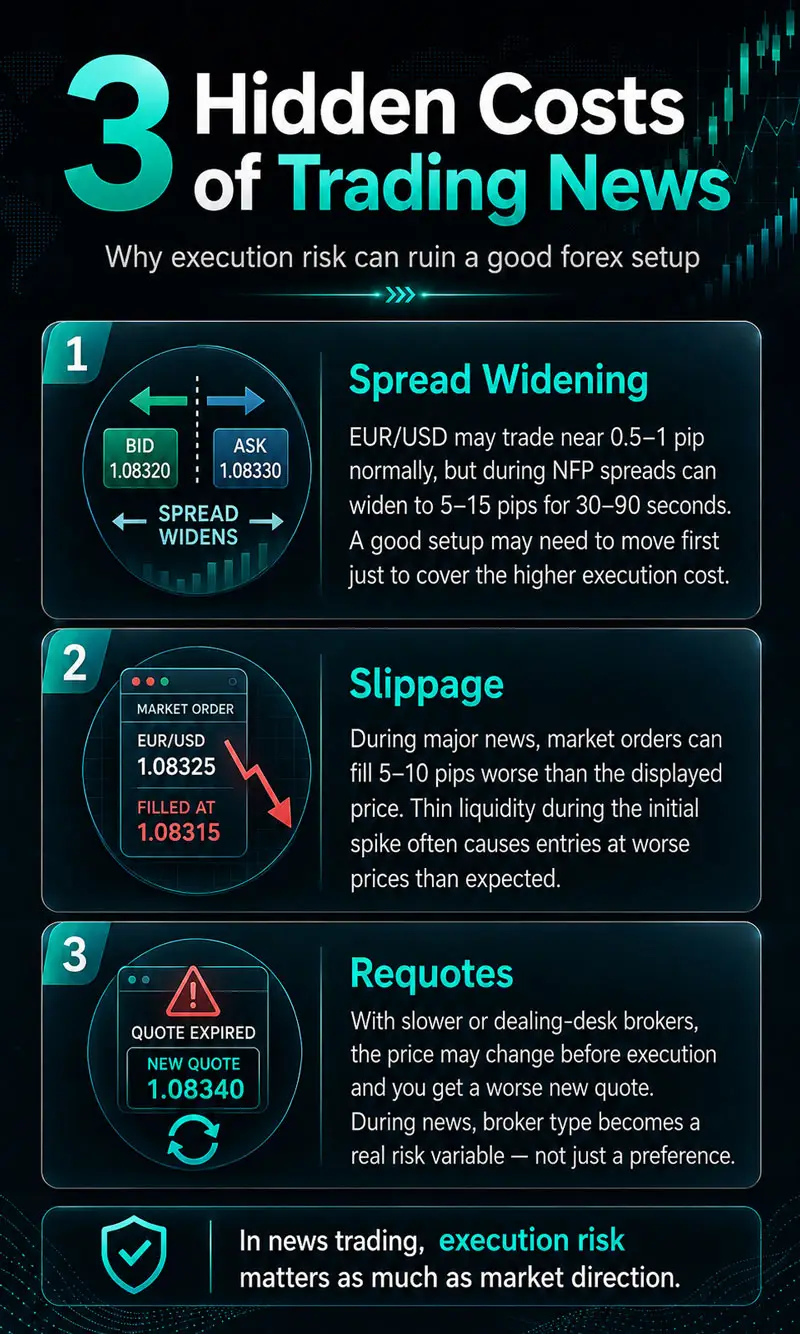
Slippage. Market orders during news can fill 5–10 pips worse than the price you see. Liquidity fragments at price extremes during the initial spike because large market participants pull their orders ahead of the release. Your order fills in a thin market at worse prices than displayed.
Requotes. With slower or dealing-desk brokers, the price changes between your order submission and execution, and the broker presents a new — worse — price. Understanding what requotes are and how to avoid them around news events is practically essential if you plan to trade major releases regularly. Your broker type is not a preference when it comes to news — it is a risk variable.
The combined effect: a news entry that looks like a 60-pip opportunity can net 35–40 pips after spread, slippage, and execution drag. This is one of the strongest arguments for the wait-and-see approach — by 10–15 minutes after a release, spreads have typically normalized, slippage is reduced significantly, and fills are closer to the displayed price. You give up some of the initial move in exchange for far better execution quality.
ECN and STP brokers handle news execution considerably better than market makers, though even ECN spreads widen during releases. If your current broker’s spread behavior during news events is costing you more than the move is delivering, that is not a strategy problem — it is a broker problem.
Forex News Trading Inside a Prop Firm Challenge
Applying forex news trading strategies inside a funded account evaluation adds a risk dimension that most traders underestimate before their first news trade inside a challenge: the daily loss limit.
On a $50,000 PropLynq 2-Step challenge — the most popular plan, with a 5% daily loss limit — that ceiling is $2,500 per calendar day. A 50-pip adverse move at two standard lots on EUR/USD costs approximately $1,000. That is 40% of your entire daily loss budget, in under a minute. Add a widened spread and slippage on a poorly timed news entry, and a single news trade gone wrong can consume more daily drawdown than any technical trade would under normal conditions.
This is why position sizing for news entries needs to be meaningfully smaller than your standard trade size. The same volatility that makes news moves attractive amplifies losses when the direction is wrong. Sizing down is not timidity — it is proportionate risk management for a higher-volatility environment.
One structural advantage of PropLynq’s BYOB (Bring Your Own Broker) model is directly relevant here. Unlike prop firms that assign traders to a single in-house execution environment, PropLynq traders choose their own broker from a curated approved list — which includes IC Markets and Pepperstone, both known for tighter execution and better spread management during high-impact news events compared to proprietary platforms with wider default news spreads. The spread difference during a major release is not marginal: it can mean 5–10 pips of cost difference on entry and exit, which on a news trade is a material portion of the available reward.
News trading is permitted on PropLynq’s challenge structures, but traders should verify the current terms on the evaluation rules page before any major release, as conditions may vary by plan type. The core discipline holds regardless: size smaller for news, use the wait-and-see approach during an evaluation phase rather than pre-news positioning, and treat the daily loss limit as an absolute ceiling — not a fallback.
For traders working toward their first funded account in a prop firm, news events are both the fastest way to demonstrate edge and the fastest way to fail an evaluation. The difference comes down entirely to preparation and position sizing.
A Pre-Trade Checklist for Every Major Forex News Release
Use this before every high-impact event:
- Check the economic calendar. Note the Forecast and Previous values. What size deviation would constitute a genuine surprise? Forex Factory and TradingView both show consensus estimates alongside historical ranges for each release.
- Identify the affected currency pairs. Not every USD release produces the same reaction on every USD pair. Know which pair tends to generate the cleanest directional move for the specific event you are trading.
- Set time alerts. 30 minutes before and 5 minutes before the release. News events do not give you a grace period if you are caught in a position at the wrong time.
- Decide your approach before the number drops. Pre-news positioning, wait-and-see, or fade. Write the plan. Decisions made in the first 10 seconds after a release are almost always worse than decisions made before the number landed.
- Calculate your position size specifically for this trade. Smaller than your standard size. The volatility that makes news trading attractive also amplifies losses. Budget for a wider stop.
- Check your spread right before the release. If your broker’s spread is already widening two minutes before the announcement, execution conditions are deteriorating. Wait for the post-release window to normalize before entering.
- Know your stop and daily limit before you click. If you are inside a prop firm evaluation, calculate the maximum loss your stop allows and confirm it leaves adequate daily drawdown buffer for the rest of the session.
Forex news trading is not about execution speed. It is about knowing exactly what you are going to do before the number lands on the screen. The traders who profit consistently from news events are not faster — they are already decided.
If you are ready to put these strategies to work with real funded capital, get a funded account and see how your forex news trading approach holds up under real challenge conditions.
Miles Rowan Keene
As Senior Market Strategist at PropLynq, I write about market structure, trading psychology, and risk-first execution. My focus is on turning complex market behavior into clear, actionable lessons for both developing and experienced traders. I specialize in educational content covering funded account rules, drawdown management, trade planning, and strategy refinement, with the goal of helping traders build consistency through discipline, preparation, and a deeper understanding of how professional trading environments operate.
Weekly Trading Insights
Market analysis and trading tips delivered every Monday. No spam, unsubscribe anytime.
Comments
All comments are reviewed before publication · Text only · No links
No comments yet — be the first.